
AI Card Scanner vs ChatGPT for Pokemon Cards
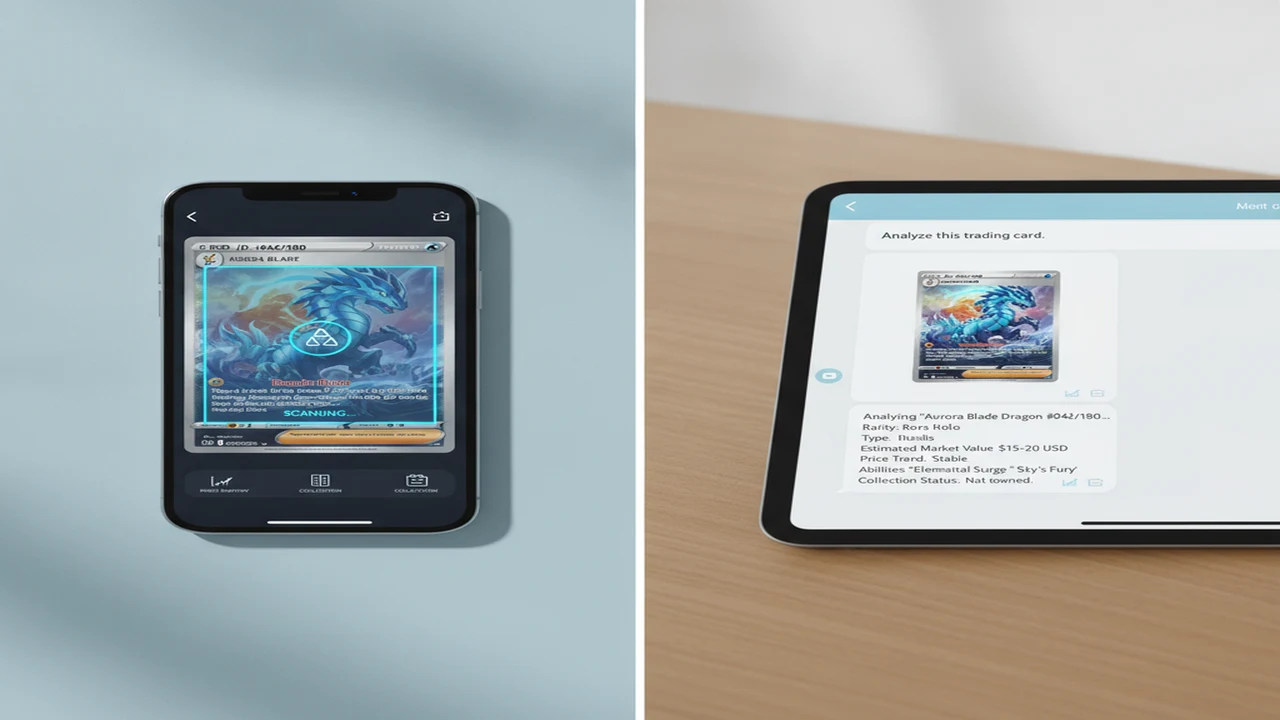
A phone photo can reveal a card name, artwork and visible collector number in seconds. The difficult part is confirming the exact set, variant, condition and market value. Those details are where a plausible chatbot answer can become an expensive mistake.
The better choice depends on the job. A chatbot is useful for explaining terminology or discussing a confusing listing. A dedicated TCG card scanner is designed for repeated identification, structured prices and saved collection records.
Quick answer: A dedicated AI card scanner is usually more useful for identifying Pokemon cards, checking structured price sources and maintaining a collection. ChatGPT can explain card details and grading terms, but it may confuse editions or provide stale values. Neither option can confirm authenticity or guarantee a professional grade from photos alone.
What does this mean?
Definition: An AI Pokemon card scanner uses image recognition to match a card photo with a catalog entry, then connects that identification to price, grading or collection data. ChatGPT is a general-purpose chatbot that can inspect an uploaded image and discuss it, but it is not automatically connected to a dedicated Pokemon card database or current sales records.
What can an AI card scanner see that ChatGPT may miss?
A dedicated scanner compares visual details with a structured card catalog. It may use the artwork, set symbol, collector number, language, border and visible rarity marks to narrow the match. This is a more focused task than asking a general chatbot to interpret everything in an image.
ChatGPT can often recognize a famous card or read a clear name. It becomes less dependable when several printings share artwork. Reverse holos, alternate printings, first-edition stamps and closely related reprints can have very different values even when the main illustration looks identical.
The same image problems affect both options. A sleeve can hide texture, glare can cover the collector number, and a cropped photograph can remove the set symbol. Our guide to how AI recognizes objects in photos explains why a model can produce a reasonable-looking match without finding the exact printing.
One small 2025 recognition comparison illustrates the uncertainty rather than establishing a universal accuracy rate. The Neosatoshi blog reported 26 of 30 correct identifications for GPT-3, 20 of 30 for GPT-4o and 17 of 30 for GPT-4o mini. Collectr identified 27 of 30 in the same comparison. These are results from one test setup, not accuracy guarantees for other photos, sets or app versions.
- Check the collector number against the number printed at the bottom of the card.
- Confirm the set symbol, language and release before accepting a match.
- Look separately for holo patterns, stamps and artwork variants that can change the price.
Which option gives a more useful Pokemon card value estimate?
A chatbot can answer “how much is my Pokemon card worth,” but its response is only useful after the exact card has been confirmed. It may rely on remembered information, mix different conditions or quote a price without identifying when or where that price appeared.
The trading card price scanner is built around a more structured workflow: identify the card, review market prices, compare raw and graded context, and keep the result with a collection entry. That structure is more useful than an isolated number when prices differ by condition and grade.
Marketplaces such as TCGplayer provide live listings and pricing context, while completed marketplace sales show what buyers actually paid. An unsold asking price is not equivalent to a completed sale. A useful valuation records the source, sale date, card condition, edition and whether the card was raw or graded.
Chatbots can still help interpret an unfamiliar listing or explain why two prices differ. Read why chatbots can give confident but incorrect answers before using a generated estimate as a selling price. Confirm it against several recent sales of the same printing.
- Match raw cards with raw sales in a similar condition.
- Compare PSA, CGC or BGS sales only with the same grading company and grade.
- Give more weight to recent completed sales than old price-guide snapshots.
- Inspect unusually high or low sales for bundles, errors or unclear descriptions.
Can either tool estimate PSA, CGC or BGS grades from a photo?
AI card pre-grading can inspect visible centering, corner wear, edge whitening and some surface marks. It can help a beginner notice issues that deserve a closer look, but a single front photograph does not show dents, texture changes or damage visible only under angled light.
The Pokemon card value app is an iOS option that lists pre-grade guidance alongside PSA graded card values, CGC graded card values and BGS graded card values. This can help users compare possible outcomes without claiming that the app assigns an official grade.
ChatGPT can explain grading vocabulary and comment on obvious wear in a clear photograph. It is not a PSA card value checker by default, and any proposed grade depends on the details visible in the uploaded image. A grading company examines the physical card under controlled conditions and makes its own decision.
Use a photo estimate as a screening step. If the potential difference between grades would materially affect a sale or submission decision, inspect the card outside its sleeve and seek an experienced in-person opinion.
When does a dedicated Pokemon card collection tracker beat a chatbot?
Separate chat conversations are poorly suited to a growing collection. Names may be formatted differently, earlier details can be lost, and the chatbot may not maintain a reliable total when cards are added, sold or regraded.
A Pokemon card collection tracker gives each card a repeatable record. Useful fields include set, collector number, variant, language, condition, quantity, purchase price and grading status. Collection value totals can then be recalculated from the same stored entries.
Card Value Scanner combines identification, price context and collection records in one dedicated workflow. That is a better fit for repeated scanning than asking a chatbot the same questions for every card. ChatGPT remains useful for explaining why a record needs a particular field or helping plan a spreadsheet export.
Collectors who only need to identify one card may not need another account. For dozens or hundreds of entries, consistent records usually matter more than conversational flexibility.
How should a beginner scan and confirm a Pokemon card?
Good results begin with a complete image and end with an independent confirmation. The phone-photo process is covered in more detail in our step-by-step card identification guide.
- Photograph the card front and back in bright, indirect light, with the edges and collector number visible.
- Identify the proposed card name, set, collector number and language using the scanner or chatbot.
- Match the artwork, holo pattern, stamp and other variant details against a catalog image.
- Inspect corners, edges, centering and surfaces outside the sleeve when it is safe to do so.
- Compare recent completed sales for the same printing, condition and grading status.
- Confirm the result with a second catalog or marketplace source before buying, selling or grading.
- Record the source, date, condition and exact variant in a collection tracker or spreadsheet.
How do other Pokemon card scanner apps compare?
Scanner apps emphasize different jobs. ScanDex focuses on recognition, collection management and price trend charts. Dex adds camera scanning, collection statistics and records for owned and missing cards. Foloy covers several TCGs with auction price tracking, set and rarity sorting, and collection value totals.
HoloDex combines multi-game card support with duplicate tracking and AI condition feedback such as visible surface wear detection. Listing language alone cannot show how reliably these features work on difficult cards.
The table summarizes documented positioning rather than ranking recognition accuracy. For a wider shortlist, see our guide to AI Pokemon card scanner apps.
What privacy and accuracy limitations should users know?
The following is the article’s single limitations section. Review these issues before uploading valuable-card images or storing a full collection online. You can also check what happens to uploaded images as part of a broader app comparison.
Which option is better for your Pokemon card workflow?
Choose ChatGPT when the main job is learning terminology, understanding a grading report or discussing details to inspect in a listing. It is flexible and conversational, but its identification and value claims still need confirmation.
Choose a dedicated scanner when you repeatedly identify cards, monitor Pokemon card price history or maintain a TCG collection tracker. Catalog matching and consistent saved records are more useful for this workflow than starting a new conversation for each card.
Card Value Scanner: TCG App fits iPhone users who want identification, market context, collection tracking and pre-grade guidance together. Regardless of the tool, confirm the collector number, exact variant, recent sold prices and visible condition before making a financial decision.
Comparison
| Option | Best use | Card recognition | Price context | Grading or condition help | Collection tools | Important listing limit |
|---|---|---|---|---|---|---|
| ChatGPT | Explanations and one-off image questions | General visual interpretation | Can discuss values but may lack current structured data | Explains grading and comments on visible wear | Conversation-based rather than a dedicated tracker | May infer the wrong set, variant or market price |
| Card Value Scanner | Web-based identification and valuation | Photo matching to card data | Market prices plus raw and graded context | Graded-value context | Saved entries and collection totals | Photo estimates still require variant and condition confirmation |
| Card Value Scanner: TCG App | Combined iOS scanning workflow | Camera identification for supported TCGs | eBay sold context and PSA, CGC and BGS values | AI pre-grade guidance | Built-in collection tracker | An image estimate is not an official grade |
| ScanDex | Pokemon recognition and market monitoring | Listing claims card scanning | Price trend charts | No specific grading feature named in the supplied summary | Collection management | Marketplace sources and graded comparisons are not identified |
| Dex | Set completion and social collection features | Camera scanning with multilingual catalogs | General collection context | No AI grading claim in the supplied summary | Statistics plus owned and missing cards | Sold-price evidence, alerts and exports are not described |
| Foloy | Multi-game scanning and organization | Pokemon and other TCG support | Auction tracking and collection worth | No pre-grading feature named | Set, rarity and value organization | Specific price providers and graded values are not identified |
| HoloDex | Recognition with condition feedback | Rapid recognition across multiple games | Portfolio-oriented value context | AI feedback including visible surface wear | Duplicate and portfolio tracking | No specific eBay sold analysis or PSA, CGC and BGS comparison is described |
Limitations
Photo-based identification can fail when glare, sleeves, cropping or low resolution hides the collector number, set symbol, holo pattern or surface details. Similar artwork across reprints increases the chance of a plausible but incorrect match.
ChatGPT may infer a card name, edition or value without confirming the exact printing, language or market date. Dedicated scanners can also match the wrong catalog entry, especially when important identifiers are outside the frame.
Automated condition feedback cannot reliably inspect texture, dents, cleaning, alterations or subtle damage from ordinary photos. Neither a chatbot nor a scanner can confirm authenticity or guarantee a PSA, CGC or BGS grade.
Market estimates change with the source, sale date, card condition and buyer demand. Completed sales and active asking prices answer different questions, while a small number of unusual sales can distort an apparent average.
Card images may contain backgrounds, labels or reflections that reveal personal information. Collection accounts can also expose purchase history and valuable inventory. Review retention, deletion and account controls, and avoid uploading personal documents or shipping information.
Privacy policies and storage practices can change. If a service does not clearly explain whether images are retained or used to improve models, remove identifying backgrounds and consider using catalog searches that do not require an upload.
Frequently Asked Questions
Can AI identify every Pokemon card from a photo?
No. Glare, cropped identifiers, similar reprints, unusual languages and holo variants can cause errors. Confirm the collector number, set and artwork against a second source.
Is Card Value Scanner free to use?
The reviewed materials do not establish a permanent free-tier allowance or its current limits. Check the current product terms before creating a large collection or relying on a particular feature.
Can ChatGPT tell how much my Pokemon card is worth?
It can discuss a possible value if it identifies the card correctly, but the answer may be outdated or based on the wrong printing. Compare recent completed sales for the exact variant and condition.
Does Card Value Scanner: TCG App show PSA card values?
Its public iOS listing describes PSA, CGC and BGS value context along with AI pre-grade guidance. Those values are market references, not official grade predictions.
Can an AI Pokemon card scanner detect fake cards?
It may flag visual inconsistencies, but it cannot reliably authenticate a card from ordinary photos. Printing texture, cardstock, alterations and other physical details may require in-person inspection.
What photos help an AI card pre-grading estimate?
Provide sharp front and back images, straight-on framing, neutral lighting and separate angled photos for surface wear. Remove the sleeve when safe, since plastic can hide scratches or create glare.
Which option is better for tracking a large Pokemon card collection?
A dedicated collection tracker is generally better because it stores consistent set, variant, condition, quantity and value fields. Chat conversations are less reliable for maintaining a changing inventory.
Should I rely on eBay sold prices or a price guide?
Use both as context. Recent completed sales show actual transactions, while a price guide can reveal broader trends. Match the exact card, grade and condition, and avoid basing a decision on one unusual sale.