
How AI Pokemon Card Scanners Work and Where They Fail
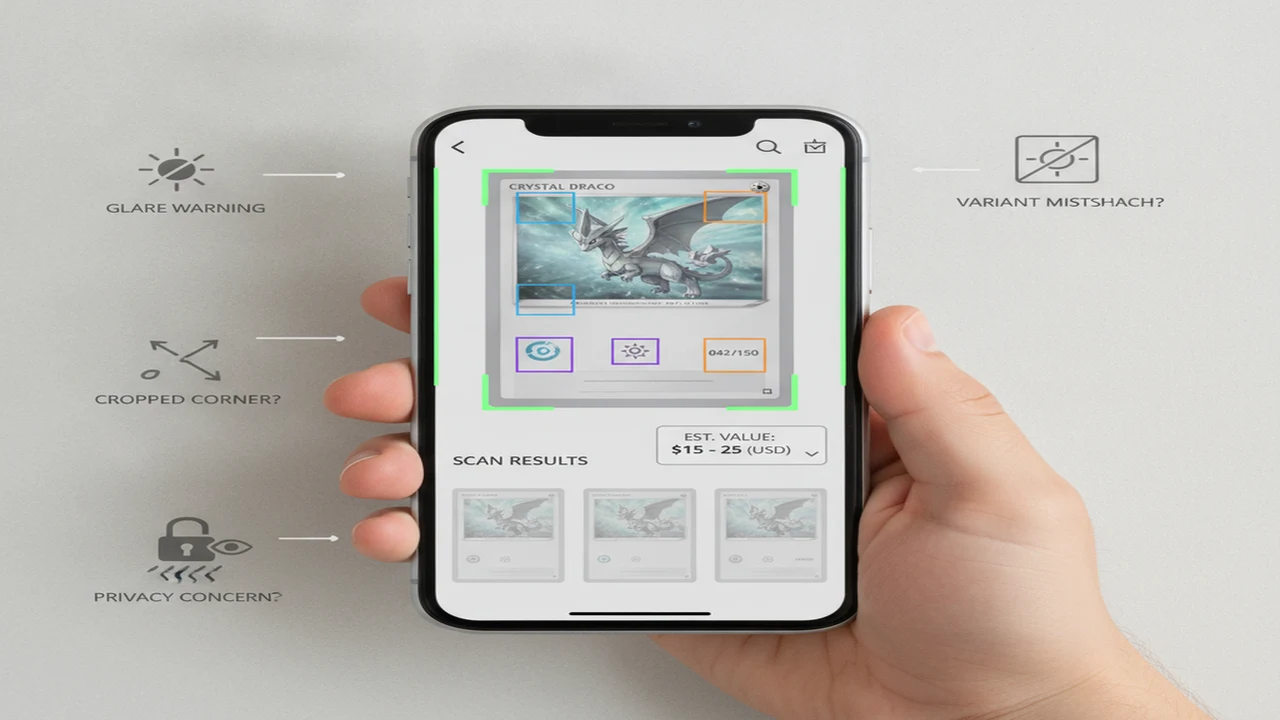
A phone camera can recognize many Pokemon cards in seconds, but the result is not produced by the app understanding the card like a collector does. The software works from visible pixels and database records. It cannot see a card's ownership history, feel a surface dent or know whether an apparently accurate print is genuine.
The useful question is therefore not simply whether a scanner uses AI. Beginners should ask what information the model can see, how it chooses a database match and where pricing or condition assumptions enter the workflow.
Quick answer: AI Pokemon card scanners analyze a camera image, read visible details such as the name, artwork, set symbol and card number, and compare them with a card database. Results depend on photo quality, database coverage and the correct variant match. These apps can speed up identification and collection tracking, but condition, authenticity and estimated value still require human confirmation.
What does this mean?
Definition: An AI Pokemon card scanner is an app that uses image recognition to identify a card from a photo, match it with a database entry and display details such as its set, variant, estimated condition or recent market value.
What does an AI Pokemon card scanner actually see?
The scanner receives a grid of pixels from the camera. It looks for the rectangular card boundary, artwork, text blocks, borders, color patterns, set symbols and collector numbers. Image recognition can compare the overall design, while optical character recognition attempts to read printed text.
Many systems combine both methods. Artwork can narrow the search, and a readable collector number can distinguish between candidate records. The process is explained more fully in our guide to identifying a Pokemon card from a phone photo.
Only visible information is available. A front image does not reveal hidden creases, back-surface wear, ownership history or whether the card was altered. Even a sharp photograph provides less evidence than examining the card from several angles under controlled light.
How does the app turn a card photo into a database match?
The first stage detects the card and corrects perspective so a tilted photo resembles a flat scan. The app may then adjust brightness, reduce background clutter and isolate areas containing artwork or text.
The extracted features are compared with candidate records in a Pokemon card database. A dedicated scan TCG cards workflow can connect that identification step with card details and collection tools. Public documentation describes capabilities, but it does not provide an independent accuracy measurement.
Database size matters because the correct print must be available before the model can select it. Eyevo TCG reported in 2024 that its scanner compared images with a database of more than 18,000 Pokemon cards. That figure illustrates the scale involved, not the accuracy of every scan.
- Photograph the entire card in even light.
- Crop the image around the card boundary.
- Recognize artwork, layout and readable text.
- Match those features against database candidates.
- Confirm the set, collector number and finish.
- Compare pricing records for the same variant and condition.
- Save the confirmed record to a collection.
How does a scanner estimate Pokemon card market value?
Identification and valuation are separate jobs. After selecting a likely database record, a Pokemon card price checker looks for market information associated with that exact print. Sources can include marketplace feeds, completed transactions and price histories.
Edition, language, finish and condition can change the estimate substantially. A raw card should not be compared directly with a graded copy, and PSA graded card values are not automatically equivalent to CGC graded card values or BGS graded card values.
The eBay sold price checker describes eBay sold-price analysis, comparisons involving PSA, CGC and BGS, AI card pre-grading and collection tracking. These are documented features rather than a guarantee that every displayed result represents the final sale value of a particular card.
Recent sales are usually more informative than active asking prices. Users should still inspect the dates, conditions and exact variants behind a Pokemon card market value estimate.
Why can two nearly identical Pokemon cards produce different results?
The same artwork may appear in an original set, a reprint, a promotional release or a regional edition. Reverse holo and standard versions can also share most of their design. Small collector-number, set-symbol or copyright-line differences may be decisive.
Language matters because demand and marketplace records differ by region. A scanner trained mainly on English cards may also have fewer reference images for foreign-language releases.
Before saving a result, compare the printed collector number, set symbol, language, finish and edition marker with the proposed database entry. If the app presents several candidates, do not choose solely by artwork.
Where do AI card scanners fail most often?
Scanner errors usually come from missing visual evidence, incomplete database coverage or assumptions made after identification. A reported benchmark should be read narrowly. For example, Curiosa reported in 2025 recognition above 95% for standard Pokemon releases under its stated typical front-image conditions. That does not establish performance for damaged cards, unusual variants or other apps.
- Glare, sleeves, shadows, blur, tilted framing and cropped corners can hide details needed for recognition.
- Similar artwork can lead to the wrong reprint, reverse holo, promotional card or regional edition being selected.
- AI card pre-grading cannot inspect texture, dents, surface damage, print defects or alterations as reliably as an in-person grader.
- A price result may mix asking prices with completed sales or overlook differences in condition, language, edition and graded population.
- A normal camera scan cannot reliably prove authenticity because a convincing counterfeit may reproduce visible artwork and text.
- Uploaded images and collection records may reveal valuable holdings. Review camera permissions, retention policies, account security and export controls.
- Free tiers may limit scans, saved cards, history, alerts or grading features. Current allowances should be confirmed in the relevant listing.
When is a dedicated scanner better than a general chatbot?
A chatbot that accepts images may identify a familiar card or explain visible text. It may also guess when the image is unclear, and its response might not be connected to a structured card database.
A dedicated TCG card scanner is better suited to repeated scanning, exact candidate selection, collection portfolios, price history and records that can be updated later. Our AI card scanner versus ChatGPT comparison explains why a specialized database often matters more than a conversational answer.
HoloDex is another option described as supporting multiple card games and collection portfolios. Its public listing does not establish every pricing, profit-and-loss or export capability, so users should confirm the functions important to their workflow.
A chatbot remains useful for explaining terminology or helping interpret a result. It is less suitable as the only record system for a large collection.
What should beginners confirm before trusting a scan?
Start with the collector number and set symbol, then confirm the language, finish and edition. Open the market records behind the estimate and compare recent completed sales for cards in similar condition.
If a grade is suggested, read it as a screening estimate rather than a promised professional grade. For an expensive card, review several photographs and multiple sales records. Consider an experienced dealer or professional grader when authenticity or condition would materially affect a transaction.
Check camera and photo-library permissions before uploading a collection. Also confirm whether images are processed on the device or sent to a server, how long records are retained and whether collection data can be exported or deleted.
Plan details can change, so consult current product documentation for scan allowances and supported games. Our overview of the best AI Pokemon card scanner apps provides a broader starting point for comparing documented workflows.
- Confirm the card number, set and printed language.
- Check whether the card is standard, holo, reverse holo or promotional.
- Compare completed sales rather than relying on one headline price.
- Separate raw-card estimates from professionally graded values.
- Review permissions, data retention and account security.
- Verify current free-tier limits and paid-plan features.
Comparison
| Scanner stage | What the AI uses | Likely output | Common failure | What the user should confirm |
|---|---|---|---|---|
| Camera capture | Card edges, lighting and focus | Cropped card image | Glare or missing corners | The full front is visible |
| Card identification | Artwork, text and layout | Likely card name and set | Similar artwork | Name, set symbol and number |
| Variant matching | Finish, symbols and small print | Specific database record | Wrong holo or reprint | Edition, language and finish |
| Condition estimate | Visible corners, edges and surface | Approximate condition range | Hidden dents or texture damage | Multiple angles and back image |
| Market-value lookup | Sales and marketplace records | Estimated value range | Mismatched condition or variant | Recent comparable completed sales |
| Collection entry | Chosen record and user data | Saved card and portfolio value | Incorrect match becomes permanent | Record accuracy and export options |
Limitations
Frequently Asked Questions
Can an AI scanner identify every Pokemon card?
No. Results depend on image quality, database coverage and whether the app supports the card's language, set and variant. Promos, miscuts, reflective cards and visually similar reprints are more likely to require manual confirmation.
Can TCG App estimate a card's condition from a photo?
Its public documentation describes AI card pre-grading. A photo-based estimate can flag visible wear, but it cannot fully assess texture, dents, alterations or damage hidden by lighting and sleeves. It should not be read as a guaranteed professional grade.
Does Card Value Scanner show real eBay sold card prices?
The Apple App Store listing describes eBay sold-price analysis. Users should inspect the underlying date, variant, condition and graded status where available because a completed sale for a similar-looking card may not be a valid comparison.
Can a Pokemon card scanner detect fake cards?
Not reliably from a normal photo. Image recognition can notice obvious inconsistencies, but convincing counterfeits may copy artwork and text. Authentication may require examination of print quality, card stock, texture, dimensions and other physical details.
Are PSA, CGC and BGS graded card values interchangeable?
No. Buyers may value the grading companies and individual grade levels differently. Compare sales from the same company and grade when possible rather than applying one PSA card value checker result to CGC or BGS slabs.
Can the same scanner identify One Piece and Disney Lorcana cards?
Some multi-game scanners support Pokemon, One Piece and Disney Lorcana, but coverage differs by app and region. Check the current supported-game list and confirm whether identification, pricing and collection tools are available for each game.
Do Pokemon card scanner apps have free tiers?
Many offer limited access, but allowances can change. A free tier may restrict scans, saved cards, price history, alerts or AI grading features. Read the current listing rather than assuming that a feature shown in screenshots is included without payment.
Is it safe to upload photos of a valuable card collection?
It depends on the app's data practices and your account security. Review camera access, cloud processing, image retention, deletion controls and export options. Avoid including addresses, faces or other identifying details in the background of card photographs.