
How to Identify a Pokemon Card From a Phone Photo
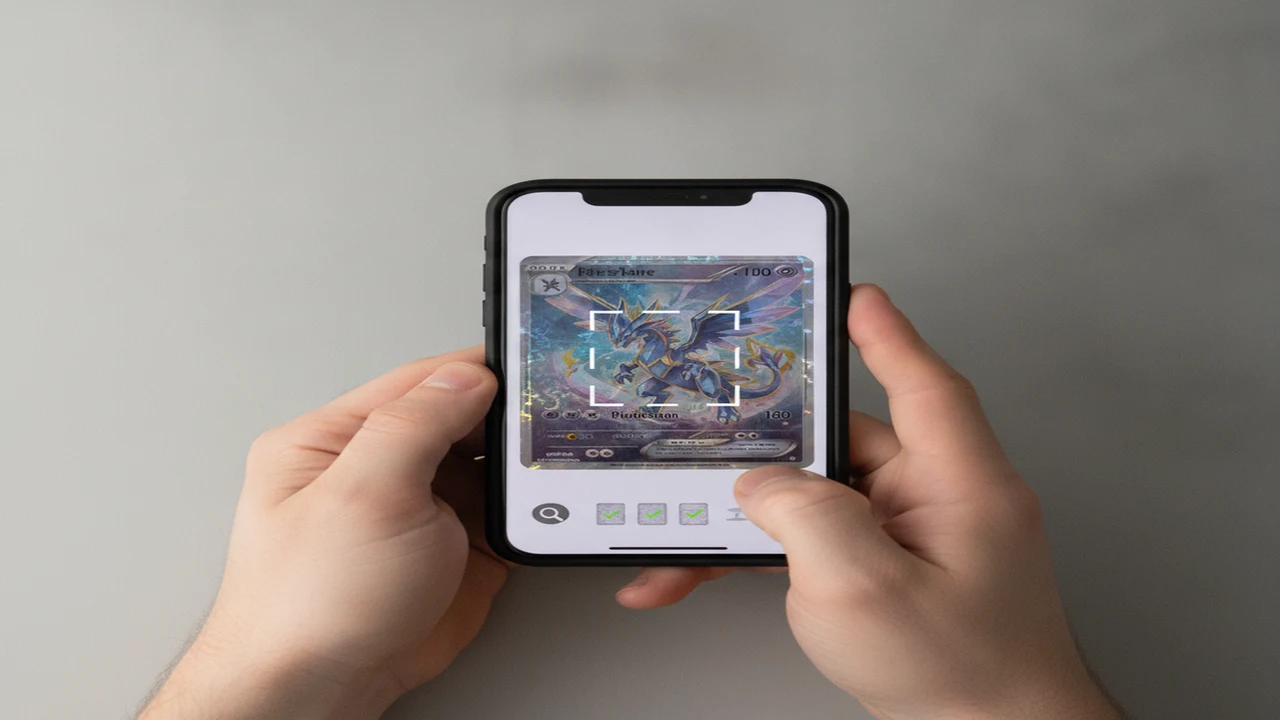
A phone photo can narrow an unfamiliar Pokemon card down to a likely match in seconds, but the first result is not always the exact printing. Cards can share a name and artwork while differing by set, collector number, foil treatment, language, or promotional release.
The safest workflow separates three questions: What card is this, what condition is it in, and what have comparable copies sold for? Image recognition can help with the first question. Condition, authenticity, and value still require additional checks.
Quick answer: Take a sharp, evenly lit photo that shows the whole card, then use a dedicated Pokemon card identifier to match its name, artwork, set symbol, and collector number. Confirm those printed details before checking prices. A chatbot can describe the image, but a trading card scanner app is usually better for structured identification, market data, and collection tracking.
What does this mean?
Definition: Phone-photo card identification uses image recognition and visible card details, such as artwork, text, set symbols, and collector numbers, to suggest a matching Pokemon card and its specific printing.
What details should appear in the phone photo?
The image recognition system can only use details that are visible in the photo. Show the full front of the card, including all four corners, the card name, artwork, attack text, collector number, rarity mark, and set symbol. Avoid cropping the bottom edge, where several of the most useful identifiers usually appear.
Use a plain, contrasting background and steady, even light. A modern phone camera is normally sufficient when the lens is clean and the card is in focus. Glare across a foil surface can hide text or make artwork colors look different, while deep shadows can obscure the set symbol.
Photograph the card straight on rather than from a steep angle. If the app struggles with a reflective card, move the light or phone slightly instead of using flash. A sharp image from an ordinary camera is more useful than a high-resolution image with glare or missing edges.
How do you scan a Pokemon card step by step?
A dedicated tool such as TCG market value scanner can use the photo for identification and then provide price context for the suggested printing. Follow the same capture routine each time so that errors are easier to spot.
Large card databases make photo search possible, but database size does not guarantee a correct match. PriceCharting reported in 2022 that its photo search could identify millions of cards across trading card games and that its catalog contained more than 50,000 unique Pokemon card entries, according to its photo-search announcement.
- Remove the card from a binder pocket, top loader, or cloudy sleeve when it is safe to do so.
- Position it flat on a plain surface with every edge and corner visible.
- Light the card from the sides to reduce shadows and reflections.
- Focus by tapping the card name or collector number on the phone screen.
- Photograph the full front without flash, blur, fingers, or background clutter.
- Scan the saved image or open the camera inside the card identifier.
- Compare the suggested name, artwork, set, number, language, and variant with the physical card.
- Confirm the printing rather than accepting the first visually similar result.
- Check market information only after the identity and raw or graded status are correct.
- Save the confirmed card to a collection tracker if you want to monitor it later.
How do you confirm that the suggested card is the correct printing?
Start with the collector number. A number such as 4/102 identifies both the card's position and the size of its set, making it more useful than artwork alone. Search the card name and full number together if the scanner offers several candidates.
Next compare the set symbol, copyright year, language, rarity mark, and artwork. Check whether the physical card is non-holo, holo, reverse holo, a promotional release, or another variant. Some versions use nearly identical artwork but have different numbering, borders, stamps, or foil placement.
A saved Card Value Scanner result should still be checked against the printing on the card. Identity is separate from condition: matching the correct database entry does not determine whether the card is near mint, lightly played, altered, or counterfeit.
For a closer look at why visual matches can fail, see how AI Pokemon card scanners recognize images and where they make mistakes.
What should you do when the scanner gets the card wrong?
Retry in a fixed order. Clean the camera lens, remove reflective protection when appropriate, change the lighting angle, place the card on a plain background, and take a new straight-on photo. Crop away excess background without cutting off the card's borders.
If recognition still fails, enter the collector number and card name manually. You can also search by language, year, set symbol, and a distinctive attack name. This often works better for damaged cards or printings that share artwork.
ScanDex is another TCG card scanner that lists card identification, card value lookup, price trend charts, and collection management. Its public listing does not specify every marketplace source or promise graded-price comparisons, export, or batch scanning, so confirm which functions are available in the version you use.
How should you check the card's price after identifying it?
Do not use the first active listing as the card's value. Sellers can ask any price, and unsold listings do not show what buyers recently paid. Prefer completed sales for the exact printing, language, condition, and foil variant, then examine several recent transactions rather than one unusually high or low result.
TCG card value checker is a companion option for live TCG price checks and collection organization. Card Value Scanner can also place an identified card into market and graded-price context. Neither should be considered a formal appraisal, particularly when the card's condition is uncertain.
Keep raw cards separate from graded cards. PSA graded card values, CGC graded card values, and BGS graded card values can differ because the label, numerical grade, grading company, and card population affect buyer behavior. A raw-card estimate should not be replaced with a grade 10 sale simply because the card looks clean in a photo.
For more choices and feature differences, consult our guide to AI Pokemon card scanner apps for 2026. When reviewing any Pokemon card price checker, look for the marketplace, sale date, condition, and whether shipping is included.
When is a dedicated card scanner better than a chatbot?
A dedicated scanner is usually better when you need repeatable database fields, instant camera card identification, a Pokemon card price tracker, or a Pokemon card collection tracker. It can connect the image to a structured entry containing the set, collector number, variant, and market records.
A general chatbot is more flexible when you need printed text explained or want help understanding why two candidates differ. It may describe the card correctly while selecting the wrong set or variant, especially when the collector number is blurred. Our card scanner and ChatGPT comparison explains this difference in more detail.
Before uploading, check whether processing happens on the phone or in the cloud, whether photos are retained, and whether they may be used to improve a model. Avoid including faces, addresses, receipts, account details, or identifiable room contents around the card.
Also inspect account and free-tier terms. A tool may allow identification while limiting saved cards, price history, alerts, or collection totals. TCG App may suit someone who wants pricing and organization together, while a manual collector-number search can be enough for an occasional card.
What are the limitations of identifying cards from photos?
Comparison
| Check | What to inspect | Why it matters | Common mistake |
|---|---|---|---|
| Card name and artwork | Exact spelling, character, pose, and background | Narrows the possible card family | Assuming shared artwork means the same printing |
| Collector number | Both numbers and any promotional prefix | Usually provides the strongest printing clue | Reading a blurred 8 as a 3 |
| Set symbol | Shape, letters, or expansion mark | Separates similar releases and reprints | Ignoring a small symbol near the bottom |
| Year and language | Copyright line and printed language | Can affect identity, demand, and price | Using an English price for a foreign-language card |
| Foil or reverse-foil pattern | Where the reflective layer appears | Variants can have different market records | Selecting holo based only on glare |
| Raw versus graded status | Slab company, grade, and certification details | Raw and graded prices are not interchangeable | Applying a grade 10 sale to an ungraded card |
| Recent sold prices | Exact variant, condition, date, and marketplace | Completed sales show actual transactions | Relying on active asking prices |
Limitations
Image recognition can confuse cards that share artwork across sets, reprints, promotional releases, or foil variants. Foreign-language cards, unusual editions, damaged cards, and counterfeits may also fall outside the scanner's strongest database coverage.
Photo quality remains a major constraint. Sleeves, glare, shadows, cropped corners, low resolution, and worn collector numbers can hide the evidence needed for a reliable match. Retaking the image may improve identification, but it cannot restore information that is no longer visible on the card.
A correct identity does not confirm authenticity, physical condition, or professional grade. AI card pre-grading may point out visible centering or surface issues, but a phone photo can miss scratches, dents, print lines, edge wear, and alterations. An AI card grading app cannot promise a PSA 10 or replace inspection by a grading company.
Prices can be incomplete or delayed and may vary by marketplace, date, language, condition, location, and graded status. Users should also verify photo-retention policies, cloud processing, account requirements, and free-tier limits before scanning valuable cards or building a large Pokemon card portfolio tracker.
Frequently Asked Questions
Can a phone camera identify any Pokemon card?
No. A phone camera can identify many cards when the front is clear and the relevant printing exists in the tool's database. Heavy damage, glare, unusual languages, obscure releases, and counterfeit cards can produce weak or incorrect matches.
What is the most reliable detail for confirming a Pokemon card?
The full collector number is often the strongest starting point because it connects the card to a particular set. Confirm it with the set symbol, language, artwork, year, and foil variant rather than relying on one detail alone.
Can Card Value Scanner identify cards inside sleeves?
It may recognize a card through a clear sleeve, but reflections, dust, texture, or cloudy plastic can hide important details. If the first result is uncertain, remove the sleeve only when doing so will not risk damaging the card.
Does TCG App show raw and graded Pokemon card values?
Its public product information positions it for live price checks and collection organization, with graded-price context available within the broader companion workflow. Check the current interface and data source before assuming that every card or grading company is covered.
Can an AI card grading app tell whether a card will receive a PSA 10?
No. AI card pre-grading can estimate visible centering and surface quality, but photographs may hide dents, fine scratches, edge wear, print defects, and alterations. Only the grading company determines the grade it assigns.
Are eBay sold Pokemon card prices more useful than active listings?
Usually, because completed sales show prices that buyers actually paid. Use several recent sales for the exact printing and condition, exclude obvious outliers, and check whether shipping or bundled items affected the total.
Can a Pokemon card identifier detect counterfeit cards?
It may notice mismatched artwork or text, but identification is not authentication. Counterfeits can copy visible designs, while photos may conceal incorrect card stock, texture, ink, or foil construction. Valuable cards may require expert inspection.
Should I upload valuable card photos to an AI chatbot?
Only after reviewing its privacy and retention settings. Crop out faces, addresses, receipts, certification account screens, and room details. For sensitive collections, consider a tool with clear deletion controls or on-device processing.