
From AI Guess to Sold Listing: A Beginner's Process
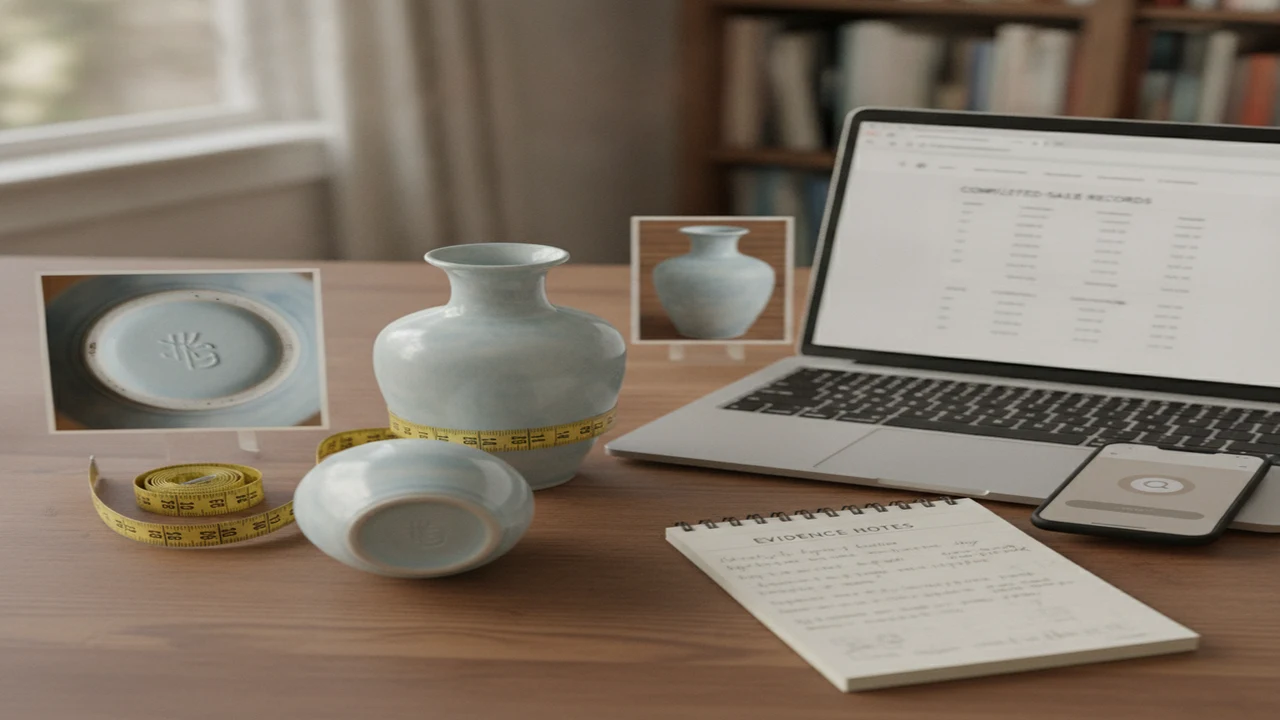
Taking a photograph and receiving an antique name feels like the hard part. It is only the beginning. Image recognition can notice shapes, decoration, lettering, and surface marks, but a plausible visual match may still have the wrong maker, material, age, or price.
A beginner-safe workflow preserves uncertainty until the evidence becomes stronger. You gather useful photographs, ask for possible identities, extract searchable clues, confirm those clues independently, examine completed sales, account for condition, and disclose what remains uncertain in the listing.
Quick answer: AI can turn clear photographs and visible marks into a useful identification lead, but it cannot establish an antique's identity or value by itself. Confirm the suggestion with maker references, measurements, material clues, condition evidence, and genuinely comparable sold listings. The safest path runs from photographs to a supported identity, then to a cautious listing range rather than one AI-generated number.
What does this mean?
Definition: An AI-to-sold-listing process uses image recognition to suggest what an object may be, then checks identifying details and completed sales before creating a description and realistic price range.
What should you gather before asking AI to identify an antique?
An AI antique identifier sees pixels. It does not know an object's ownership history, weight, sound, smell, hidden construction, or what is inside a watch movement or piece of furniture. Better evidence gives the model a narrower task and gives you material that can be checked later.
Use bright, even lighting, sharp focus, and a plain background. Photograph several distinct angles instead of repeatedly submitting one front view. Our guide to what AI can learn from an antique photograph explains why visible details matter more than an attractive composition.
For porcelain marks identification, capture the entire piece and an upright close-up of the base mark. Antique silver identification needs hallmarks, handles, joints, wear, and a scale reference. An antique watch value inquiry needs the dial, case, case back, crown, movement if safely accessible, and reference numbers. Antique furniture identification benefits from joints, hardware, drawer construction, feet, undersides, and repaired areas.
Crop faces, addresses, personal papers, reflections, and unrelated rooms before uploading. Disable or remove location metadata when possible, particularly when photographing a valuable collection at home.
- Full object from the front, back, sides, base, and top
- Labels, maker signatures, hallmarks, symbols, and model numbers
- Joints, fasteners, hardware, seams, and construction details
- Chips, cracks, repairs, wear, stains, and missing components
- Height, width, depth, weight when available, and a safe scale reference
How do you turn clear photos into a useful AI identification guess?
You can use Antique Identifier to appraise antiques by picture and organize the visible clues. Submit the strongest views and ask for an object category, possible maker, likely material, approximate period, style, visible marks, and the visual reasons behind each suggestion.
Phrase the request as an investigation rather than a demand for certainty. Ask which details support the proposed identity and which details conflict with it. When the image is ambiguous, request two or three plausible alternatives and a short list of photographs or measurements that would distinguish them.
Antique Identifier TIQ offers a structured, category-focused route for image input. A dedicated antique identifier app can be easier for repeated photographs and collection records, while a general chatbot is useful for turning observations into better research questions. Neither format turns an unsupported visual resemblance into confirmed attribution.
How can you confirm the maker, material, and period?
Copy the exact wording from labels and marks. Record initials, punctuation, symbols, model or pattern numbers, dimensions, mark shapes, construction methods, and any country or material wording. Search those details separately instead of searching only the broad AI label.
Google Lens can help you search antiques by photo, but open the matching pages and inspect their evidence. Confirm important clues through museum collections, established maker references, auction archives, specialist guides, or WorthPoint where suitable access is available. Two independent forms of support are better than several AI answers repeating the same visual assumption.
Antique Identifier By Picture is another option, with background object removal and period identification. User reviews report changing scans and occasional maker or region errors, so its suggestions still need checking. Curio - Antique Identifier offers photo antique identification, historical background, and origin or period details. These are research leads rather than certificates.
Save candidate identities and their supporting clues in Antique Identifier TIQ or a separate research document. Keep rejected possibilities too. A note explaining why an attribution failed can prevent the same weak match from returning later.
How do you find sold listings that actually match the object?
A sold price records a completed transaction. An active asking price records what a seller hopes to receive, while an auction estimate is a pre-sale expectation. An AI-generated antique market value range may summarize uncertain inputs and should not replace the underlying records.
Search with a formula: confirmed maker or object category + material + pattern or model + dimensions + likely date range + condition. Prioritize completed records with clear photographs and descriptions matching the maker, size, material, construction, age, completeness, and condition.
The size of a marketplace does not make every result comparable. eBay reported $22.6 billion in gross merchandise volume and 133 million active buyers for Q4 2024 in its 2024 earnings release. That scale can produce useful records, but it also produces copied titles, mistaken attributions, reproductions, and highly varied selling conditions.
When asking how much is my antique worth, focus on several defensible matches rather than the highest result. Visually similar objects can sell very differently because of attribution, rarity, restoration, provenance, completeness, or venue. The distinction between structured scanning and general chat is covered in our antique scanner and chatbot comparison.
How should condition and missing information change the price range?
Record chips, hairline cracks, repairs, replaced parts, refinishing, oxidation, missing accessories, non-working movements, odors, and incomplete sets. Antique Identifier TIQ can hold visible condition clues, but a photograph may not reveal adhesive, internal damage, unstable materials, or skilled restoration.
Avoid asking AI for a universal percentage deduction. Look for sold examples of the same or closely related object in damaged, average, and stronger condition. Build a low scenario from weaker or uncertain comparables, a middle scenario from the closest matches, and a high scenario from better examples that still resemble the item accurately.
The range is not the same as the seller's proceeds. Marketplace fees, buyer premiums, shipping costs, currency conversion, sale date, return risk, and local demand can change the outcome. If condition or attribution remains uncertain, widen the range and explain why.
How do you write an accurate listing from the confirmed evidence?
Use a title formula such as: object type + confirmed maker or attributed maker + material + pattern or model + approximate period + important condition fact. Include only terms supported by photographs, marks, measurements, or dependable references.
Separate facts from interpretation. State a maker directly only when confirmed. Use cautious wording such as “attributed to,” “appears to be,” “possibly,” or “date unknown” when the evidence is incomplete. Give dimensions, mark transcriptions, repairs, missing parts, operating status, and exactly what the buyer will receive.
AI can turn notes into readable copy, but review every sentence. Remove invented provenance, rarity, authenticity, materials, or maker claims. Keep original photographs and research notes so buyers can inspect the same evidence. Do not copy another seller's description or images, even when the object looks identical.
When does a dedicated app beat a chatbot or human appraiser?
A dedicated antique identifier app is useful when you want guided image capture, repeatable prompts, and organized collection records. A chatbot is often better for planning searches, explaining unfamiliar terminology, or editing a description after the facts have been checked. Google Lens is useful for broad visual matching, although results may include copied listings, reproductions, and mislabeled objects.
Once you have a likely identity, an antique price guide or sold-sales database is usually more useful than another image scan. Antique Identifier TIQ can support the earlier identification and record-keeping stages, but higher-stakes conclusions may require a qualified antique appraiser, auction specialist, watchmaker, jeweler, or relevant category expert.
Seek human help for rare, insured, disputed, high-value, regulated, or difficult-to-ship objects. Also confirm current free tiers, scan allowances, advertising, exports, privacy terms, and subscription conditions because public listings can change.
What final checklist takes an AI guess to a sold listing?
Do not publish an important maker, period, or material claim until at least two independent forms of evidence support it. Save comparable URLs, sale dates, prices, photographs, condition notes, and permitted screenshots so you can revisit the range if the market changes.
Before publishing, check marketplace fees, packing and shipping risk, insurance needs, return terms, and whether the item's potential value justifies specialist review.
- Photograph the object, marks, construction, measurements, and condition.
- Identify a likely category and several plausible attributions.
- Extract exact wording, symbols, numbers, dimensions, and material clues.
- Confirm important claims through independent specialist references.
- Compare genuinely similar completed sales rather than asking prices alone.
- Adjust the range for condition, completeness, venue, fees, and date.
- Disclose confirmed facts, visible faults, included parts, and uncertainty.
- Publish only after reviewing the title, photographs, price range, and terms.
Comparison
| Evidence source | What it can tell you | What must match | Main weakness | How much weight to give it |
|---|---|---|---|---|
| Exact completed sale | A real transaction for the same identified object | Maker, model, size, material, period, condition, and completeness | Venue, date, fees, or unusual bidding may affect the result | High when documentation and photographs are clear |
| Close completed comparable | A defensible range when no exact sale exists | Category, quality, construction, age, dimensions, and condition | Small attribution or condition differences may have a large effect | Medium to high, using several records |
| Active marketplace listing | Current seller expectations and available supply | The same identifying and condition details | The asking price may never attract a buyer | Low for value, useful for market context |
| Auction estimate | A specialist's expected pre-sale range | Attribution, catalog details, condition, and sale location | It is not the final hammer price or seller proceeds | Medium when the catalog entry is well supported |
| AI value estimate | A starting range or suggested search direction | The app's assumed identity and comparable objects | Inputs and matches may be unclear or visually based | Low until the underlying evidence is confirmed |
Limitations
Image recognition can assess visible shapes, colors, text, marks, and surface condition. It cannot confirm hidden construction, weight, provenance, internal movements, or every repair. Different crops, lighting, backgrounds, and angles can also produce different identifications for the same object.
Rare objects, regional makers, reproductions, worn marks, and mixed or replaced parts can lead to confident but incorrect labels. An AI estimate or antique value checker result is not a certified appraisal and may rely on visually similar items rather than verified sold matches. Completed prices also vary by condition, venue, fees, buyer premiums, location, currency, shipping, and date.
Uploaded photographs may expose faces, addresses, reflections, location metadata, serial numbers, or collection records. Review the current privacy policy for cloud processing, retention, account data, deletion, and reuse terms. IBM's 2023 global survey found that 77% of consumers would be unwilling to buy from a company known to use their data without consent, while 71% were more likely to use a company that clearly explained AI use and data protection.
Free scans, advertisements, exports, subscription prices, and usage limits may change after the article date. These limits do not make AI identification unusable, but they are reasons to confirm the current terms. High-value, rare, insured, regulated, or disputed objects may require an appropriate human specialist.
Frequently Asked Questions
Can AI identify an antique from one photo?
One clear photograph may suggest an object category, style, or possible period, but it rarely supplies enough evidence for confirmation. Add views of the back, base, sides, construction, damage, measurements, labels, and marks. A likely match should then be checked against maker references and other independent sources.
Are sold listings more reliable than an antique price guide?
Recent completed sales often reflect current buyer behavior better than an older antique price guide. However, the sold objects must genuinely match the maker, size, material, age, condition, and completeness. A dated guide can still help with terminology, patterns, production periods, and uncommon objects that rarely appear in marketplace records.
What photos are needed for porcelain marks or silver hallmarks?
Take a full-object photograph, a close-up of the mark, a view showing where the mark appears, and an image with safe scale. Include the base, rim or edge, handles, joints, and damaged areas. Angled light can reveal impressed porcelain marks, shallow engraving, worn silver hallmarks, repairs, and surface texture that flat lighting hides.
Can an antique identifier app tell whether an item is authentic?
It can point out visible antique authenticity clues and suggest what deserves closer inspection. It cannot reliably confirm hidden construction, material composition, provenance, internal parts, or sophisticated reproductions from photographs alone. Authentication may require physical examination, reference measurements, material testing, movement inspection, or a specialist familiar with the maker and category.
Is Antique Identifier TIQ free to use?
Antique Identifier TIQ may have current download, scan, advertising, or subscription conditions described in its public listing. Confirm the latest allowances and renewal terms directly before uploading a large collection because free tiers, image limits, exports, and paid features can change after this article's August 6, 2026 review date.
Should I use Antique Identifier TIQ or a general chatbot?
Use Antique Identifier TIQ when you want a structured image-based workflow and a place to organize candidate identities or collection details. A general chatbot is useful for refining search phrases, explaining marks, or editing confirmed notes into listing copy. Important maker, material, period, and value claims still require outside evidence.
When should I contact a professional antique appraiser?
Seek human help when an object may be highly valuable, authenticity remains unclear, an insurer needs documentation, ownership is disputed, or fragile shipping creates substantial risk. Watches, jewelry, regulated materials, rare regional work, specialist furniture, and objects with possible museum or auction interest may require a watchmaker, jeweler, appraiser, conservator, or category expert.