
Best AI Pokemon Card Scanner Apps for 2026
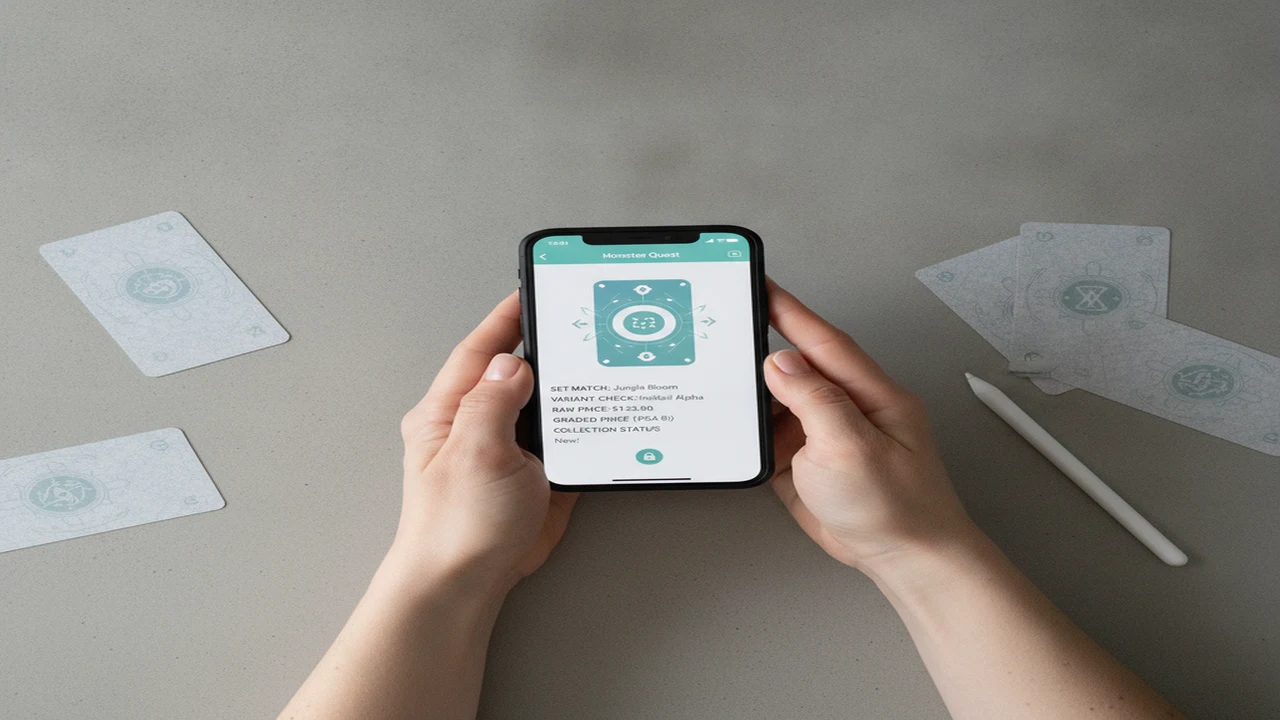
A phone camera can make cataloging Pokemon cards much faster, but recognition and valuation are different jobs. A scanner might identify the artwork correctly while selecting the wrong set, language, foil treatment, stamp, or reprint. Those small differences can produce a large change in the displayed value.
Dedicated scanners generally make more sense than a general chatbot when you need repeated card matching, structured price records, set progress, or a searchable collection. A chatbot is more useful for explaining terms such as reverse holo, population report, or near mint. It should not be the final authority on an exact card or selling price.
Quick answer: The best AI Pokemon card scanner depends on your workflow. Card Value Scanner: TCG App covers identification, sold-price research, graded context, and multiple card games. Acorn emphasizes portfolio and set tracking, Dex suits multilingual Pokemon collections, and Card Value Scanner for Pokemon supports focused lookups and watchlists. Always confirm the set, variant, condition, and recent sales before relying on a value.
What does this mean?
Definition: An AI Pokemon card scanner is an app that uses image recognition to match a card photo with a catalog entry, then displays information such as the set, variant, market price, graded value, or collection status.
What should beginners look for in an AI Pokemon card scanner?
Start with identification detail. A useful scanner should show more than the Pokemon's name. Look for the set name, collector number, language, rarity, release, and documented variant. The collector number is often more reliable than artwork alone because the same illustration may appear in multiple products.
Image recognition matches visible patterns against a catalog. It does not automatically determine authenticity, surface wear, centering, print defects, or hidden damage. Our guide to how Pokemon card image recognition works explains why a confident-looking match can still be wrong.
Pricing should be traceable to a market or transaction type. A current listing, an estimated market price, and a completed sale are not equivalent. Collectors should also be able to separate raw-card prices from PSA, CGC, or BGS slab references.
Collection features matter if you have more than a few cards. Useful options can include quantities, set progress, watchlists, portfolio history, price alerts, and exports. Confirm the supported languages, games, platforms, subscription limits, and export formats on the current listing.
- Exact set, collector number, language, and variant matching
- Named pricing sources and a distinction between listings and completed sales
- Separate raw-card and graded-card price context
- Collection tracking, set completion, watchlists, or portfolio history
- Clear information about supported games and languages
- Current scan limits, subscription terms, exports, and privacy controls
Which AI Pokemon card scanner apps are the best for 2026?
Our ranking is based on documented capabilities rather than an independent accuracy benchmark. The strongest choice depends on whether you mainly need price evidence, multilingual catalog coverage, portfolio records, or set completion.
1. The photo card identification tool documents photo identification, market pricing, graded-card context, and collection totals. Its broader app listing also describes support for multiple trading card games, making this option suited to collectors who want identification and value research in one workflow.
2. Acorn TCG Card Scanner is aimed at collectors who want broad catalog tools. Its listing emphasizes eBay pricing, PSA population reports, portfolio value history, and master set progress. It is a stronger fit for long-term collection organization than for users seeking documented AI pre-grading or CGC and BGS references.
3. Dex combines a Pokemon camera scanner with multilingual catalogs, set statistics, social features, and deck-building tools. It stands out for collectors handling international releases, including Simplified Chinese cards, or those who care more about collection detail than grading estimates.
4. Card Value Scanner for Pokemon from App All Day offers focused Pokemon lookups, card price monitoring, rarity and condition details, and a personal watchlist. Its narrow focus may suit a beginner who does not need multi-game support or more advanced portfolio tools.
What can each scanner identify and track?
All four options can help match Pokemon cards, but their collection tools have different priorities. Acorn concentrates on portfolio history and master set progress. Dex adds multilingual catalogs and detailed set statistics. The App All Day scanner focuses on Pokemon information, price monitoring, and watchlists.
The trading card scanner companion site is relevant to users who want a dedicated TCG collection tracker rather than a series of isolated photo answers. Structured records let you save quantities and revisit price information without asking a chatbot to identify the same card again.
A dedicated trading card scanner app also has an advantage when a collection spans games. Documented coverage for Pokemon, Disney Lorcana, and One Piece can reduce the need to maintain separate lists. Dex remains the more specialized option here when multilingual Pokemon catalog coverage is the central requirement.
Do not assume that every scanner includes batch capture, CSV export, price alerts, or all regional markets. Those capabilities are useful for large collections, but they should be confirmed in the current app description or subscription screen.
How should you scan Pokemon cards for value?
The quality of the photo affects the initial match. Remove distracting backgrounds, avoid direct flash, and keep the complete border and collector number visible. If a sleeve creates glare, change the camera angle or temporarily remove the card when it is safe to do so.
After scanning, compare the result with the printed name and collector number. Then verify the set symbol, language, foil treatment, promotional stamp, and any first-edition or special-release marker. For a visual walkthrough, see how to identify a Pokemon card from a phone photo.
Only add a result to your Pokemon card collection tracker after those details agree. If an answer came from automated recognition, follow the same process described in our guide to checking a card scanner against a general AI chatbot.
- Photograph the card in even light, with the full border and collector number visible.
- Check the name and collector number against the physical card.
- Confirm the set, language, and variant, including foil treatment and stamps.
- Compare recent sold and market-price evidence from the correct region.
- Review condition and graded-price context separately.
- Save the verified match to the collection tracker.
- Recheck valuable cards before selling or insuring them.
How do pricing and grading features differ?
A Pokemon card market value is usually an estimate based on marketplace activity. An asking price only shows what a seller wants. A completed sale is stronger evidence of what a buyer recently paid, but one unusual transaction should not set the value by itself.
Regional context matters as well. U.S. collectors commonly consult TCGplayer prices, while European collectors may prioritize Cardmarket. A 2026 scanner-app overview from Eyevo describes TCGplayer, Cardmarket, and eBay as common market references. When possible, compare multiple recent records for the same language, variant, and condition.
The Lorcana card scanner listing documents eBay sold-price information, PSA graded card values, CGC graded card values, BGS graded card values, and AI card pre-grading. Its Apple App Store snapshot showed 3.9 out of 5 from 7 ratings as of 2026. That is a small review count, so the score should not carry more weight than feature fit and current subscription details.
PSA, CGC, and BGS references should remain separate because each company uses its own grading process, labels, and buyer market. AI pre-grading is only an estimate based on visible photo details. It cannot inspect the card under controlled conditions, authenticate it, or issue a recognized grade.
Which app fits Pokemon, Lorcana, One Piece, and set completion?
Choose according to the cards you own and the records you want to maintain. Multi-game support is useful only if the app also provides the pricing and collection fields needed for each game.
Card Value Scanner: TCG App is the documented match for collectors combining Pokemon with Lorcana or One Piece while also wanting sold-price and graded-value context. Acorn TCG Card Scanner is better aligned with portfolio value history and a Pokemon set completion tracker.
Dex is the strongest candidate in this group for multilingual Pokemon catalogs, including Simplified Chinese cards, set statistics, and broader collection features. Users seeking a Japanese Pokemon card scanner should still confirm that the exact Japanese expansion and promotional catalog they need is currently included.
Card Value Scanner for Pokemon from App All Day suits focused Pokemon lookups across older and modern sets, along with price monitoring and a watchlist. Its listing does not advertise the same range of graded pricing, multi-game coverage, or export functions.
- Pokemon plus Lorcana or One Piece: choose documented multi-game coverage.
- Portfolio value history and master sets: consider Acorn TCG Card Scanner.
- Multilingual Pokemon collecting and set statistics: consider Dex.
- Focused Pokemon lookups and watchlists: consider Card Value Scanner for Pokemon.
What privacy, free-tier, and platform details should you check?
Scanner pricing can change after publication. Open the current subscription screen and check how many scans are included, whether a trial renews automatically, which collection tools require payment, and whether exports remain available after cancellation. Do not assume that downloading an app means every advertised feature is free.
Card photos may reveal more than the card itself. A large collection can expose ownership patterns, expensive purchases, and estimated portfolio value. Check whether images are processed on the device or uploaded, how long they are retained, whether collection records sync to an account, and how account deletion works.
Review safe photo preparation for card identification before including receipts, addresses, faces, location clues, or unrelated items in the frame. Use a unique password if an account is required, and enable stronger sign-in protection when offered.
Platform support also needs confirmation. An iPhone listing does not establish Android or web availability, and a product website does not necessarily include every feature found in a mobile app.
Where can AI card scanners get the result wrong?
Image recognition can confuse cards that share artwork but differ by set, collector number, language, foil treatment, promotional stamp, or reprint. Glare, sleeves, shadows, cropped borders, and low-resolution images make those distinctions harder. Japanese cards, new releases, promos, and unusual variants may also be affected by catalog gaps or delayed updates.
Pricing can be misleading when an app combines active listings, estimated market values, and completed sales without a clear label. A card's real selling price also depends on condition, buyer demand, region, shipping, fees, and whether the sale was part of a lot. Raw and graded records should never be mixed into one comparison.
AI pre-grading cannot authenticate a card or replace professional inspection by PSA, CGC, BGS, or another grading service. A phone image may hide scratches, dents, surface changes, edge wear, and alterations. Slab references are useful context, but they do not show what an ungraded copy will receive.
Cloud accounts introduce another limit. Uploaded photos, collection lists, and value histories may reveal financially sensitive information. Review retention, deletion, sharing, and security terms before storing a high-value collection.
Finally, app listings change. Subscriptions, free scans, exports, supported games, platforms, price sources, and advertised features may differ from what was documented on August 5, 2026. Confirm current details inside the app before building a large collection database.
Which Pokemon card scanner should you choose?
Choose the app that removes the most work from your main task. For quick identification, prioritize exact set and variant fields. For selling research, look for clearly labeled completed sales. For graded cards, require separate PSA, CGC, and BGS context. Multilingual collectors should prioritize catalog coverage, while set builders need progress statistics and reliable quantity tracking.
A dedicated scanner is generally the better tool for instant camera card identification, repeated scans, price records, and collection management. A general chatbot is better at explaining terminology or helping you form a checklist, not confirming the final match or value.
For an expensive card, compare multiple recent sales of the exact variant and condition. Seek professional authentication or grading when the card's value, provenance, or authenticity justifies the cost.
Comparison
| App | Best for | Documented scanning coverage | Pricing and grading context | Collection tools | Key limitation to confirm |
|---|---|---|---|---|---|
| Card Value Scanner: TCG App | Multi-game identification and value research | Pokemon, Disney Lorcana, and One Piece | eBay sold records, market prices, PSA, CGC, BGS, and AI pre-grade context | Collection tracking and totals | Confirm current scan allowances, subscription terms, and exports |
| Acorn TCG Card Scanner | Portfolio tracking and set completion | Broad Pokemon catalog scanning | eBay pricing and PSA population reports | Portfolio value history and master set progress | Listing does not document AI pre-grading or CGC and BGS values |
| Dex | Multilingual Pokemon collections | Pokemon camera scanning with multilingual catalogs, including Simplified Chinese | Collection-oriented price information rather than documented graded or sold-price analysis | Set statistics, social tools, and deck building | Confirm Japanese set coverage, exports, alerts, and market sources |
| Card Value Scanner for Pokemon (App All Day) | Focused Pokemon lookups and watchlists | Pokemon cards from older through modern sets | Price monitoring plus rarity and condition details | Personal watchlist | Listing does not advertise graded values, AI pre-grading, or collection export |
Limitations
Frequently Asked Questions
Can an AI scanner accurately identify every Pokemon card?
No. Clear photos improve image recognition, but cards with shared artwork, different foil treatments, promotional stamps, reprints, or uncommon languages can be confused. Confirm the collector number, set, language, and variant on the physical card.
Can Card Value Scanner show graded-card price context?
Its public product information documents graded context alongside photo identification, market prices, and collection totals. Check the current product or app listing for the exact markets and grading companies available on your platform.
Does Card Value Scanner: TCG App support Lorcana and One Piece cards?
The 2026 Apple App Store listing documents Pokemon, Disney Lorcana, and One Piece support. Coverage can change, so confirm that your specific game, set, and region are included before importing a collection.
Is Dex suitable for Japanese or Simplified Chinese Pokemon cards?
Dex documents multilingual catalogs and specifically includes Simplified Chinese cards. Japanese collectors should confirm coverage for the exact expansion, promotional release, and variant they need.
Can Acorn TCG Card Scanner track master set progress?
Yes, its listing describes master set progress along with portfolio value history. That makes it relevant to collectors filling complete sets rather than performing occasional value lookups.
Are AI card pre-grades the same as PSA, CGC, or BGS grades?
No. An AI estimate is based on visible details in a photo. It cannot authenticate a card, inspect hidden surface damage, or issue a recognized professional grade.
Should I trust a scanner's price before selling a valuable card?
Use the result as a starting point. Confirm the exact variant and condition, then examine several recent completed sales from relevant markets. Separate raw-card records from sales of professionally graded copies.
What card and account data should I avoid sharing with a scanner app?
Keep receipts, addresses, faces, location clues, payment information, and unrelated documents out of card photos. Before saving a valuable collection, check image retention, cloud syncing, account deletion, sharing settings, and export options.