
Can AI Detectors Be Wrong About Human Writing?
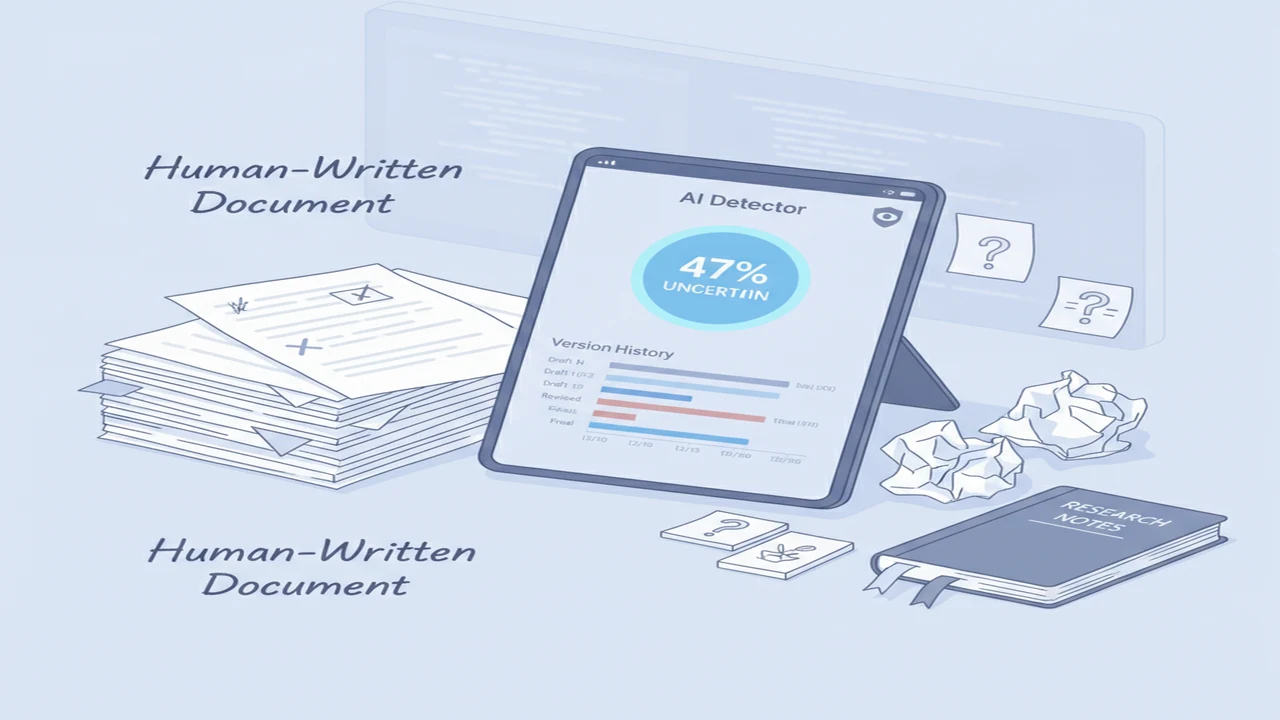
Being told that your writing “looks like AI” can feel like an accusation, especially when you wrote it yourself. The problem is that an AI Checker does not inspect your notes, watch you type, or know where your ideas came from. It analyzes the finished words and looks for statistical patterns associated with machine-generated text.
Those patterns can also appear in careful human writing. A polished report, a formulaic school assignment, a short customer email, or text revised with an AI Assistant may look predictable to a classifier. Understanding this distinction helps teachers, employers, editors, and writers respond without turning an uncertain score into a factual claim.
Quick answer: Yes. An AI content detector can label human writing as AI-generated because it estimates patterns rather than confirming authorship. Formal wording, predictable sentence structure, short samples, editing tools, and writing by non-native English speakers can affect scores. Review results alongside drafts, sources, document history, and the writer’s explanation instead of using a detector score as proof.
What does this mean?
Definition: An AI detector is software that estimates whether text resembles patterns associated with AI-generated writing; it does not directly see who wrote the text or reliably establish authorship.
Why can AI detectors flag human writing?
AI detectors classify patterns. Many look at features such as how predictable the next word seems, how much sentence length varies, and whether phrasing follows a uniform rhythm. Human writers can naturally produce the same features, so overlap is unavoidable.
Formal assignments are especially repetitive. An introduction may state the topic, several paragraphs may follow the same structure, and a conclusion may restate the argument. Business templates, product descriptions, support replies, and search-focused copy can be similarly regular.
Editing also changes the signal. Grammar correction, autocomplete, translation, accessibility software, and an AI Assistant can make sentences more consistent even when the underlying ideas and first draft came from a person. A detector sees only the submitted version unless the service specifically asks for other evidence.
Short samples create another problem because there is less writing from which to estimate a pattern. A concise answer may contain ordinary phrases and little stylistic variation. Repeated wording can have a similar effect. None of these features establishes who created the text.
- Predictable or formal wording can resemble common AI output.
- Polished grammar may reduce the irregularities associated with personal style.
- Templates and fixed assignment formats encourage repeated structures.
- Short passages provide limited evidence for classification.
- Translation, grammar, and rewriting tools can alter a human draft.
What does an AI detector actually see?
A detector receives text, converts features of that text into signals, and returns a label, score, or highlighted passages. It does not see the writer, the browser tabs used for research, handwritten notes, earlier drafts, or the thinking behind a sentence.
The web-based AI humanizer is an example of a focused interface for checking text. Its result should be understood as the tool’s estimate under its current model and settings. It is not a verified record of authorship.
A probability-style score can sound more certain than it is. A high AI label generally means that the passage resembles patterns the classifier associates with generated text. It does not mean the service observed an AI Chatbot producing the passage, and it does not identify which model or writing process was used.
General chatbots can also be asked to judge whether writing came from AI, but their response is another generated opinion rather than an authorship check. Our explanation of how an AI detector differs from a chatbot judgment covers why a focused scoring interface may be easier to repeat and document.
Error rates can vary sharply by detector and scenario. The Chicago Booth Review analysis reported in 2024 that a cited detector produced a 30% false-positive rate in one scenario and a 78% rate in another. Those figures do not describe every current product, but they show why performance claims need context.
Which kinds of human writing are easiest to misclassify?
Highly structured writing is a common concern. Academic essays, laboratory summaries, policy documents, legal-style explanations, and corporate reports often use restrained language and familiar transitions. Those conventions can reduce the stylistic variation a detector expects from human work.
Business templates create similar overlap. A person answering common customer questions may reuse approved phrases because consistency is part of the job. A resume, cover letter, property description, or short marketing summary may also follow a standard pattern without being generated by an AI Writer.
Non-native English writers may choose common words and straightforward sentence structures. Penalizing that clarity can create an unfair bias. Translation software and language-learning tools can make the final text more uniform without replacing the writer’s ideas.
Accessibility-assisted writing needs the same care. Dictation cleanup, predictive typing, spelling support, and tools that simplify sentences can affect surface patterns. The finished document alone may not reveal which parts of the workflow were assisted.
Mixed drafts are harder still. A writer might create the argument, use AI Chat for a suggested outline, rewrite every sentence, and add original evidence. A detector cannot reliably divide intellectual contribution from wording assistance. That question requires a policy and a conversation, not only classification.
What does an AI detection score really mean?
Read the wording around a score carefully. “Likely AI,” “possibly AI,” and a colored percentage may be based on different thresholds. Scores from separate services are not interchangeable because each company can use different training data, text features, models, and cutoff rules.
Highlighted passages can be more useful than an overall label because they show what deserves review. Look for boilerplate, repeated sentence openings, generic summaries, copied definitions, or abrupt style changes. Even then, highlighting identifies a pattern rather than its cause.
Disagreement between tools is normal. One AI content detector may focus heavily on predictability while another weighs sentence variation or model-specific signals. Running several detectors does not turn a majority result into confirmed authorship. It produces several estimates that may share similar weaknesses.
Scores can still help with low-stakes screening. An editor might use them to decide which passage needs a source check, or a writer might inspect language that sounds generic. The appropriate response is closer review, not an automatic accusation.
How should you respond to a possible false positive?
Start by preserving process evidence. Drafts, revision history, research notes, citations, file timestamps, and source documents can show how writing developed. This evidence is usually more directly connected to authorship than a classifier’s impression of the final prose.
Then review the passages that caused concern. Ask whether they use a required template, summarize a source, contain standard terminology, or were changed by editing software. Give the writer a chance to explain the argument and reproduce the reasoning behind it.
For a privacy-aware process, see our guide to checking AI text without sharing sensitive data. It explains why removing names or using a harmless excerpt may be safer than pasting an entire confidential document into multiple services.
- Save the original draft and version history so later edits remain visible.
- Collect notes, sources, outlines, and timestamps connected to the writing process.
- Check whether the sample is long enough for the tool to analyze meaningfully.
- Review highlighted passages instead of relying on one overall score.
- Run a second check only as another estimate, not as confirmation.
- Ask the writer to explain the drafting process and key ideas.
- Document the evidence considered and the reason for the final decision.
- Avoid penalties based only on detector output.
When is a dedicated AI Checker more useful than an AI Chatbot?
A dedicated checker is useful when you want a consistent input box, a repeatable score format, or passage-level highlighting. Those features can support an editorial workflow in which the result is saved with other review notes. They do not make the underlying classification certain.
Asking an AI Chatbot to detect AI-generated writing is less structured. The model may offer confident-sounding reasons, but it generally has no private record showing who created the text. Its explanation can also change when the prompt changes.
For an iPhone-based workflow, ACI text authenticity checker is listed as a mobile option for checking and rewriting text. The App Store listing describes detection and humanizing functions, but users should not interpret availability on iOS as an accuracy guarantee.
An AI Humanizer has a different job from a detector. It rewrites surface wording to sound less formulaic. That may be useful for improving stiff copy, but it cannot establish where the original ideas came from. Rewriting specifically to evade a school, client, or employer policy can also create a separate trust problem.
Choose a dedicated checker when repeatable scoring or highlighted passages are useful to your process. Choose AI Chat when you need broader feedback on clarity, organization, or tone. Neither option can independently confirm authorship.
What should you check about privacy and free tiers?
Pasted text may include names, customer details, unpublished research, contracts, student records, medical information, or internal plans. Before uploading it, inspect the provider’s privacy policy and current product terms. Confirm whether text is stored, used for model training, reviewed by people, or connected to an account.
Look for deletion controls and retention periods. If those details are unclear, use a non-sensitive excerpt or avoid the service. Our beginner guide to AI detector privacy and limits offers a broader checklist for choosing a service.
Free access can change. Confirm current character limits, daily checks, advertisements, account requirements, trial conditions, subscriptions, and cancellation rules. For the AI Detector App and the iOS ACI listing, rely on the terms shown when you use or download the product rather than assuming that an earlier offer still applies.
Regional App Store terms and pricing may differ. Check the storefront tied to your account, especially if a listing mentions in-app purchases or subscriptions. A free download does not necessarily mean every detection or rewriting function is free.
What are the main limitations of AI detection?
An AI Checker estimates patterns and cannot directly identify an author. Human writing can produce false positives, while generated writing can produce false negatives after paraphrasing, editing, or a change in style.
Results can shift with language, genre, sample length, formatting, and detector updates. A score obtained today may differ from a result produced later or by another service. Non-native English writing and highly formal text may face added misclassification risk.
AI Humanizer tools and ordinary rewriting can alter the visible patterns without revealing who developed the argument. Detection is therefore poorly suited to tracing ownership of ideas or measuring how much assistance was used.
There is also a privacy limitation. Confidential, student, client, legal, medical, or unpublished text may be exposed when pasted into an outside service. Redaction reduces some risk but can remove context and change the resulting score.
No single result should decide an academic penalty, employment action, publishing dispute, or fraud allegation. High-stakes decisions need documented process evidence, relevant policy, human review, and a fair chance for the writer to respond.
Comparison
| Evidence or signal | What it can indicate | What it cannot confirm | Best next step |
|---|---|---|---|
| AI detector score | The text resembles patterns associated with generated writing | Who wrote it or which tool was used | Review the score with process evidence |
| Highlighted predictable wording | A passage is repetitive, formulaic, or statistically regular | Whether the regular wording came from a person, template, or model | Read the passage in context |
| Document version history | How the draft developed over time | That every edit was made without assistance | Compare major revisions and timestamps |
| Notes and source material | The writer researched and planned the subject | Exactly how each final sentence was produced | Match notes and citations to the argument |
| Writer explanation | Whether the person understands the reasoning and sources | Authorship by itself | Ask specific, neutral questions |
| Result from a second detector | Whether another classifier finds similar patterns | A confirmed majority judgment | Record it only as another estimate |
Limitations
Frequently Asked Questions
Can an AI detector accuse a human writer by mistake?
Yes. A false positive happens when a detector labels human writing as AI-generated. Formal structure, predictable wording, short samples, templates, translation, and editing assistance can all contribute.
Can an AI content detector prove that ChatGPT wrote something?
No. It may estimate that wording resembles AI output, but it does not observe the drafting process or reliably identify a particular model. Authorship requires other evidence.
Why do different AI Checkers give different results?
Services can use different models, training examples, signals, and thresholds. The same passage may therefore receive conflicting labels. Multiple scores remain estimates rather than a vote that confirms authorship.
Can Grammarly or another editing tool trigger an AI detector?
It can affect a score because grammar correction, rewriting, autocomplete, and tone adjustments may make prose more uniform. That does not mean every edited document will be flagged.
Does short text make AI detection less reliable?
Short text provides fewer patterns for a classifier to analyze. Brief answers also tend to use common phrases, so the result should be interpreted with added caution.
Can the AI Detector App check if text is AI-generated?
The product website presents AI Detector App as a tool for checking text. Its output should be used as a screening estimate and reviewed with drafts, sources, and other process evidence.
What should users confirm before using AI Detector, AI Humanizer: ACI?
Check the current App Store description, privacy details, data handling, regional terms, in-app purchases, subscription conditions, and any limits on checks or text length. Avoid uploading sensitive material unless the handling terms meet your needs.
Should schools or employers rely on an AI detection score?
A score may support an initial review, but it should not be the sole basis for discipline or employment action. Decision-makers should consider version history, drafts, sources, policy, context, and the writer’s explanation.