
Best Crystal Identifier Apps in 2026
Quick answer: AI Rock ID is the best crystal identifier app for most iPhone users because it includes five free scans per day, saved collections and estimated values. Rock Identifier: Stone ID is the better choice for Android or an older iPhone. Pick Crystalyze if chakra, zodiac and spiritual information is your main interest.
You are at a flea market looking at a purple stone labeled amethyst. It could be amethyst, fluorite or colored glass. A crystal identifier app analyzes a photo and suggests likely matches, giving you a place to start before you spend money.
First, take a sharp photo in natural light. Then compare the result with hardness, luster, streak and crystal shape. A photo alone cannot confirm authenticity, treatment or value.
Comparison at a glance
| App | Best for | Platforms | Free version | Price | Standout |
|---|---|---|---|---|---|
| AI Rock ID | Most iPhone crystal collectors | iPhone and iPad | Five scans per day | $4.99 weekly or $29.99 yearly | Crystal details plus estimated value |
| Rock Identifier: Stone ID | Android and older iPhones | iPhone, iPad and Android | Two scans per day; seven-day trial listed | Purchases from $3.99 to $69.99 | Claims coverage of 6,000 rock and mineral types |
| Crystalyze | Spiritual crystal collections | iPhone and iPad | Free download; scan cap not confirmed | Purchases from $2.99 to $34.99 | Chakra, zodiac and moon calendar tools |
| Rock & Crystal Identifier | Crystal education and shopping | iPhone, iPad and Android | Free use stated; exact scan cap unknown | $1.99 weekly, $5.99 monthly or $29.99 yearly | Identification tied to a crystal encyclopedia |
| Crystal Identifier | Scanning one crystal in a browser | Web | One web scan per day | Free web scan; other pricing not listed | Works without installing an app |
| Mindat | Checking a suggested mineral name | Web | Browsable mineral database | Check the site | Reference records instead of photo guessing |
| Rockd | Geology maps and field notes | iPhone and iPad | Free app | Free | More than 290 geologic maps |
| AllScan AI | Scanning crystals and everyday objects | Web; mobile links listed for iPhone and Android | One web scan; mobile limit not confirmed | Check the listing | Recognizes many object categories |
Prices and ratings from the US App Store and Google Play, checked October 2026. Store prices change; the listing is the final word.
How we picked
We read the US App Store listings, available Google Play listings, developer sites, pricing pages and available help material in October 2026. We ranked the apps by crystal identification fit, free use, useful follow-up information, platform access and current pricing.
Store rating totals show audience size, not identification quality. AI Rock ID ranks above Rock Identifier: Stone ID despite having 576 ratings versus 81,888 because its five confirmed daily scans and specimen details fit this search more closely.
- The app must identify crystals or help confirm a result.
- A useful free allowance ranks above an unclear trial.
- Mineral facts count more than broad marketing claims.
- Current platform support affects who can use the app.
- Photo results must leave room for physical verification.

AI Rock ID
4.6 on the App Store (576 ratings)
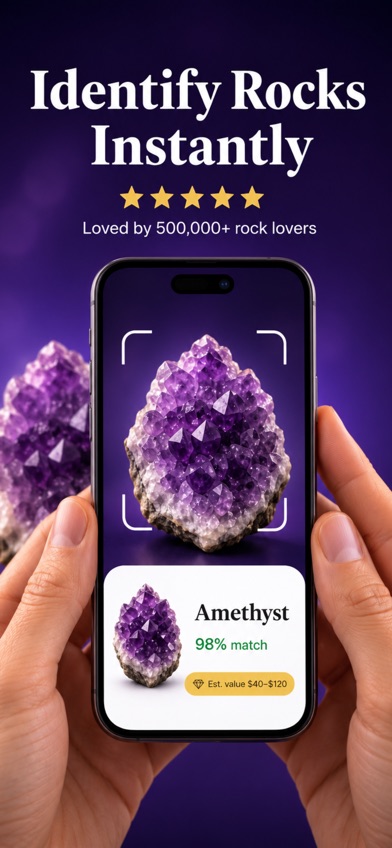
AI Rock ID is a focused iPhone and iPad scanner for crystals, rocks, minerals, gemstones and fossils. You can take a photo or upload one, then save the result to a collection. Its five free scans per day are the clearest free allowance among the specialist apps reviewed here.
The result can include the likely specimen name, Mohs hardness, chemical information, rarity and an estimated value range. Those details help with the next step. For example, you can compare a purple result with known hardness and crystal shape instead of accepting the first name shown. Estimated value is a rough app calculation, not an appraisal or proof that a gemstone is natural.
AI Rock ID had 4.6 stars from 576 US App Store ratings and was updated August 3, 2026. It is much newer than its closest rival, so its rating count is smaller. The main restriction is device support: it needs iOS 18.0 or later, and there is no confirmed Android version.
- Five free identifications each day
- Covers crystals, rocks, gemstones and fossils
- Saves scans and reports estimated value ranges
- Requires iOS 18.0 or later
- No confirmed Android app
- Photo-based value estimates are not appraisals
- Price
- $4.99 weekly or $29.99 yearly, checked October 2026.
- Platforms
- iPhone and iPad.
Pick AI Rock ID if you want several free daily scans and mineral details on a recent iPhone or iPad.
Rock Identifier: Stone ID
4.7 on the App Store (81,888 ratings)
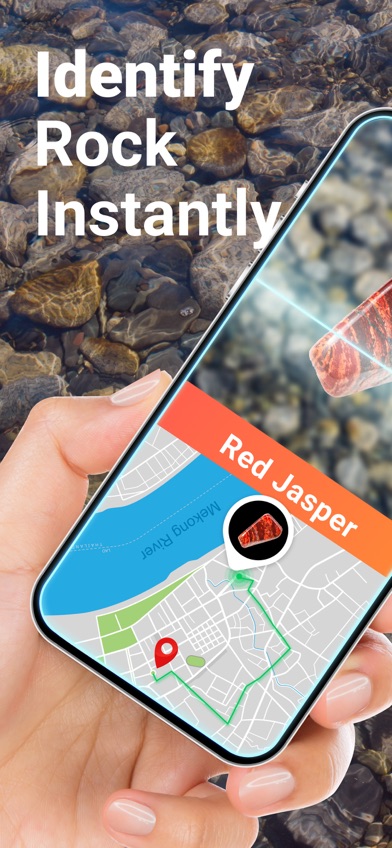
Rock Identifier: Stone ID is the closest alternative to AI Rock ID. It scans crystals, stones, minerals and gemstones, with a claimed library covering more than 6,000 types. Result pages include details such as chemical formula, hardness, color variations and likely locations.
Its main advantage is access. The app supports Android, while its iPhone version needs iOS 15.0 or later. It also has 14 languages and an iPad version. The US App Store showed 4.65 stars from 81,888 ratings, far more than any other listed app, and the last update was September 23, 2026.
The confirmed free allowance is two scans per day, with a seven-day premium trial listed. Several App Store purchase amounts appear, from $3.99 to $69.99, but the listing does not map each amount cleanly to a current plan. Check the checkout screen before agreeing to a subscription. Identification can vary when lighting or camera angle changes, so compare multiple photos and physical traits.
- Available on Android and iOS
- Supports 14 languages
- Large App Store rating history
- Only two confirmed free scans per day
- Current subscription mapping is unclear
- Price
- In-app purchases from $3.99 to $69.99 were listed in October 2026; check the current plan.
- Platforms
- iPhone, iPad and Android.
Pick Rock Identifier: Stone ID if you use Android, have an older iPhone or want a long-established scanner.

Crystalyze
4.8 on the App Store (3,422 ratings)
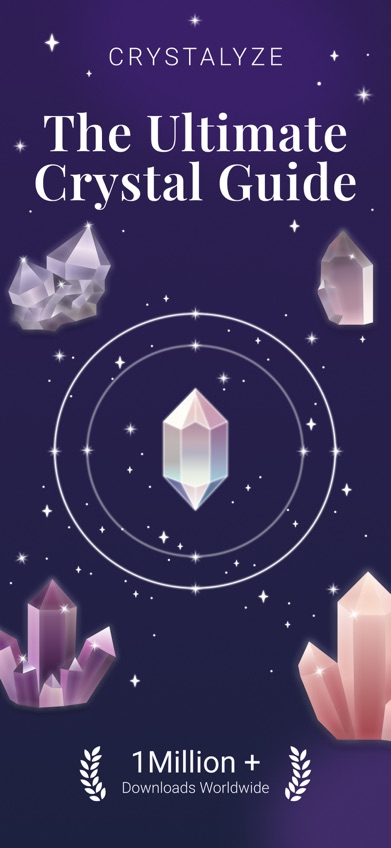
Crystalyze combines photo identification with a guide to more than 175 crystals. It is aimed at people who sort crystals by spiritual associations. You can filter entries by chakra, zodiac sign, planet, element and stated metaphysical property.
The app also has a moon phase calendar, journal, personal notes and collection groups for owned, favorite and wanted crystals. Premium adds unlimited identification and permanent identifier history according to the listing. Crystalyze had the highest App Store score in this group, 4.75 stars from 3,422 ratings, and was updated October 6, 2026.
Crystalyze is less suitable if you want geology first. Its catalog and tools give substantial space to energy work, astrology and rituals. Those subjects may match your interests, but healing claims are not medical evidence. The free download is confirmed; an official daily scan allowance was not clear in the supplied listing. Purchase options start at $2.99, with several monthly and annual amounts shown.
- Highest App Store score in this comparison
- Strong collection and journal tools
- Filters crystals by chakra and zodiac
- Only confirmed for iPhone and iPad
- Free identification limit is unclear
- Spiritual content outweighs geology
- Price
- In-app purchases from $2.99 to $34.99 were listed in October 2026.
- Platforms
- iPhone and iPad with iOS 15.0 or later.
Pick Crystalyze if spiritual associations, journaling and organizing your crystal collection are your main goals.
Rock & Crystal Identifier (Crystal Council)
4.6 on the App Store (2,779 ratings)
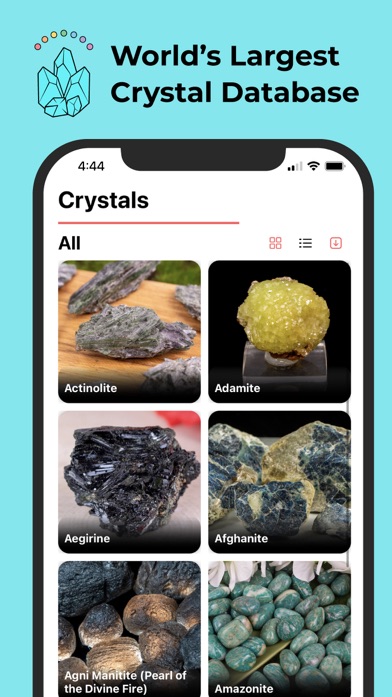
Rock & Crystal Identifier scans rocks, crystals and stones, then connects the result with encyclopedia entries and related specimens. Its listing claims a database of more than 6,000 specimens. It can also retain scan history and organize a collection with photos, origins and notes.
Filters cover color, mineral type, chakra, emotion and other spiritual categories. There is also a built-in store, with subscriber pricing attached to premium plans. That combination suits someone who wants to identify a stone and then look for a similar piece. It is less focused on neutral mineral research than AI Rock ID or Mindat.
The US App Store rating was 4.57 stars from 2,779 ratings, with an update dated September 18, 2026. Android availability is confirmed through its Google Play listing. The listings describe free use, but an official free scan count was not clear enough to quote. Paid choices are easier to understand: $1.99 weekly, $5.99 monthly or $29.99 yearly.
- Available on iOS and Android
- Collection history and notes
- Crystal guide and store in one app
- Exact free scan allowance is unclear
- Shopping and spiritual content may distract from geology
- Price
- $1.99 weekly, $5.99 monthly or $29.99 yearly, checked October 2026.
- Platforms
- iPhone, iPad and Android.
Pick Rock & Crystal Identifier if you want scanning, crystal education and shopping in the same app.
Crystal Identifier
Crystal Identifier is a web crystal scanner, so you can upload a photo without installing a dedicated app. It accepts common image formats and is intended for rough specimens, polished stones, clusters, geodes and tumbled crystals. The stated free limit is one scan per day.
A result can include a likely name, crystal system, Mohs hardness, formation details and estimated market value. This is useful when you have one unknown stone and want a quick starting point on a computer or phone. The site also explains why color alone is weak evidence: purple can appear in amethyst, fluorite, charoite and other minerals.
There is no supplied App Store or Google Play listing for this separate tool, so there is no store rating, update history or verified mobile subscription to compare. Browser uploads also mean you should check the site's current photo retention and privacy terms before sending an image that contains location metadata. Use its result as a candidate name, then confirm the physical properties elsewhere.
- Runs in a web browser
- One free scan each day
- Accepts rough and polished specimens
- No verified native app listing
- No store rating or update history
- Price
- One free web scan per day; check the site for any additional pricing.
- Platforms
- Web browsers on computers and phones.
Pick Crystal Identifier if you need to scan one specimen without installing an app.
Mindat
Mindat is a web mineral database, not a camera-based crystal scanner app. That difference is its strength. Once another app suggests a mineral name, you can search Mindat and compare the database record with the specimen in front of you.
This extra step is useful when two minerals share a color. A scanner may label a purple stone as amethyst, but the physical shape, hardness and other characteristics may point elsewhere. Mindat is better suited to research after identification than taking a quick photo at a market. It also avoids presenting a single image match as final proof.
Mindat has no supplied App Store rating, mobile app record or confirmed paid plan for this comparison. Use the website and check its current terms for account-related tools. It ranks below the photo scanners because someone searching for a crystal identifier app probably wants an immediate camera result. Still, it is the stronger pick when your real task is checking a suggested mineral name before labeling a collection or buying a specimen.
- Useful for verifying scanner results
- Focused on mineral reference records
- No automatic photo identification
- No verified native mobile app in the supplied data
- Price
- Check the site for current account and pricing terms.
- Platforms
- Web.
Pick Mindat if you already have a possible mineral name and want to research it before accepting the identification.

Rockd
4.4 on the App Store (187 ratings)
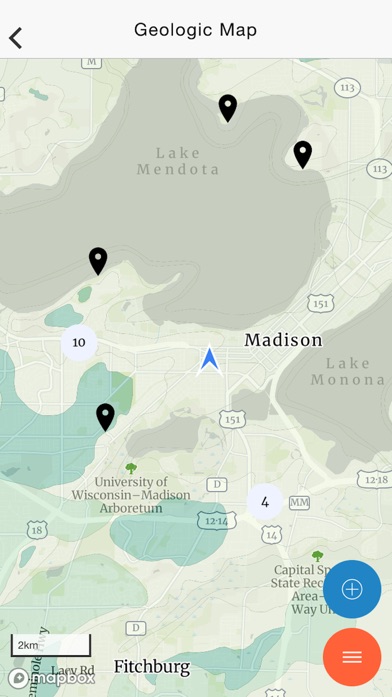
Rockd is a geology field app, not a crystal scanner. It shows geological and geographic summaries for your location, has more than 290 geologic maps and lets you save map data for field use. You can also record observations, measurements and notes.
Rockd makes more sense on a hike than at a gem counter. If you find a specimen beside a mapped rock unit, the surrounding geology can help narrow down what it might be. The app has a 3D globe, paleogeographic maps and tools for recording strike, dip, trend and plunge. Those are geology measurements, so beginners may need time to understand them.
The app is free, with no paid purchase listed in the supplied US App Store data. It had 4.38 stars from 187 ratings and was updated June 12, 2026. The confirmed Apple version needs iOS 16.6 or later and works on iPad. Choose a true crystal identifier for photo matching; choose Rockd when location, maps and field documentation are more useful.
- Free with no listed subscription
- More than 290 geologic maps
- Can save maps and field observations
- Does not identify a crystal from a photo
- Some geology tools are technical
- Price
- Free, checked October 2026.
- Platforms
- iPhone and iPad with iOS 16.6 or later.
Pick Rockd if you collect specimens outdoors and need geologic context, maps and field notes.
AllScan AI
AllScan AI is a general image scanner that includes rocks among many supported subjects. Its site describes identification for plants, animals, insects, coins, food, antiques and products. This makes it useful when you want one scanner for household discoveries instead of a dedicated crystal collection tool.
The web scanner accepts a photo and returns a likely object description. One free web scan is stated. The site also points visitors to mobile versions for iPhone and Android, but the supplied data does not include store listings, current ratings or confirmed mobile prices. Check the relevant listing before downloading or subscribing.
The broad coverage is also its main drawback for this search. A general scanner may suggest a rock or crystal name, but it does not have the clearly documented mineral fields, collection tools or specimen-focused pricing of the higher picks. If the result affects a purchase or safety decision, compare it with a mineral database and physical tests. AllScan AI ranks last because crystal identification is one category among many, not its central job.
- Scans rocks and many everyday objects
- Has a browser-based upload tool
- Only one stated free web scan
- Mobile pricing and ratings were not supplied
- Less mineral detail than specialist apps
- Price
- One free web scan is stated; check the mobile listing for current pricing.
- Platforms
- Web, with iPhone and Android download paths listed on the site.
Pick AllScan AI if you want a broad object scanner and only occasionally need a crystal suggestion.
AI Rock ID vs Rock Identifier: Stone ID
These are the closest matches for someone who wants to photograph an unknown crystal and receive mineral details. The decision comes down to free scans, phone support and how established you want the app to be.
| Point | AI Rock ID | Rival |
|---|---|---|
| Free scans | Five scans per day | Two scans per day |
| Apple requirement | iOS 18.0 or later | iOS 15.0 or later |
| Android | No confirmed Android app | Android confirmed |
| US App Store ratings | 4.6 stars from 576 ratings | 4.65 stars from 81,888 ratings |
| Languages | One language listed | Fourteen languages listed |
AI Rock ID wins for an iPhone user who wants more free daily scans and specimen details that include estimated value. Rock Identifier: Stone ID wins on Android access, older iPhone support, language choice and its much longer rating history.
Neither app can prove that a gemstone is natural, untreated or worth a quoted amount from a photo alone.
What to check before choosing a crystal scanner
Identification detail and uncertainty
A crystal scanner should give you facts that can be checked, such as hardness, luster, chemical formula or crystal shape. Be cautious when an app presents one name with no alternatives or explanation. Visually similar minerals often need a streak test, hardness test or professional examination.
Photo conditions
Use natural light, a plain background and sharp focus. Photograph more than one side, including visible crystal faces or a fresh surface when safe. If a result changes between angles, treat both names as candidates and compare their physical properties.
Geology or spiritual information
Decide what you want to learn. AI Rock ID and Mindat put more weight on mineral information, while Crystalyze and Rock & Crystal Identifier include chakra, zodiac and energy categories. Spiritual descriptions may suit a personal collection, but they are not medical or geological evidence.
Free limits, subscriptions and saved data
Check the daily scan allowance before paying. Also confirm whether saved specimens sync, survive reinstallation and require an account. Review camera, photo-library and location permissions because uploaded images may contain location metadata.
Safety and valuable specimens
Do not use a crystal scanner app to decide whether a specimen is radioactive, toxic, asbestos-bearing or safe for skin and water. Avoid scratch or streak tests on valuable polished stones. For an expensive purchase, ask a qualified gemologist for physical testing and documentation.
Frequently asked questions
What is the best crystal identifier app?
AI Rock ID is the best fit for most recent iPhones because it includes five free scans per day, saved collections and mineral details. It requires iOS 18.0 or later.
Is there a genuinely free crystal identifier app?
Crystal Identifier includes one free browser scan per day, while Rockd is fully free but does not scan crystals from photos.
Which crystal app is best for chakra and zodiac information?
Crystalyze is the strongest fit for chakra, zodiac, moon phase and spiritual collection tools.
Can an app identify a crystal from a photo?
A crystal identifier can suggest likely matches from a photo, but physical properties may be needed to confirm the mineral.
Why does the same stone get different results?
Lighting, camera angle, focus, surface weathering and mixed minerals can change what the scanner detects.
Can a crystal scanner tell if a gemstone is real?
A photo scanner cannot reliably prove that a gemstone is natural, synthetic, dyed or treated. Valuable stones need physical or laboratory testing.
What is the best site for checking a crystal app result?
Mindat is the better choice for researching a suggested mineral name and comparing it with reference information.
Which crystal identifier should you download?
Choose AI Rock ID if you have a recent iPhone or iPad and want five free daily scans with mineral details and saved collections. Rock Identifier: Stone ID is the better download for Android or older iPhones, while Crystalyze suits collections centered on chakra, zodiac and spiritual information.
AI Rock ID is the pick for multiple free daily scans
AI Rock ID is worth trying for one specific reason: it includes five free crystal, rock or mineral scans per day. That allowance is useful when you have several flea-market finds, beach stones or unlabeled pieces to sort before paying for a subscription. It suits iPhone and iPad users on iOS 18.0 or later who want likely names, mineral properties and saved results in one focused app. Confirm expensive or safety-related identifications with physical testing.