
Tool That Can Compare AI Tool Pricing and Plan Limits
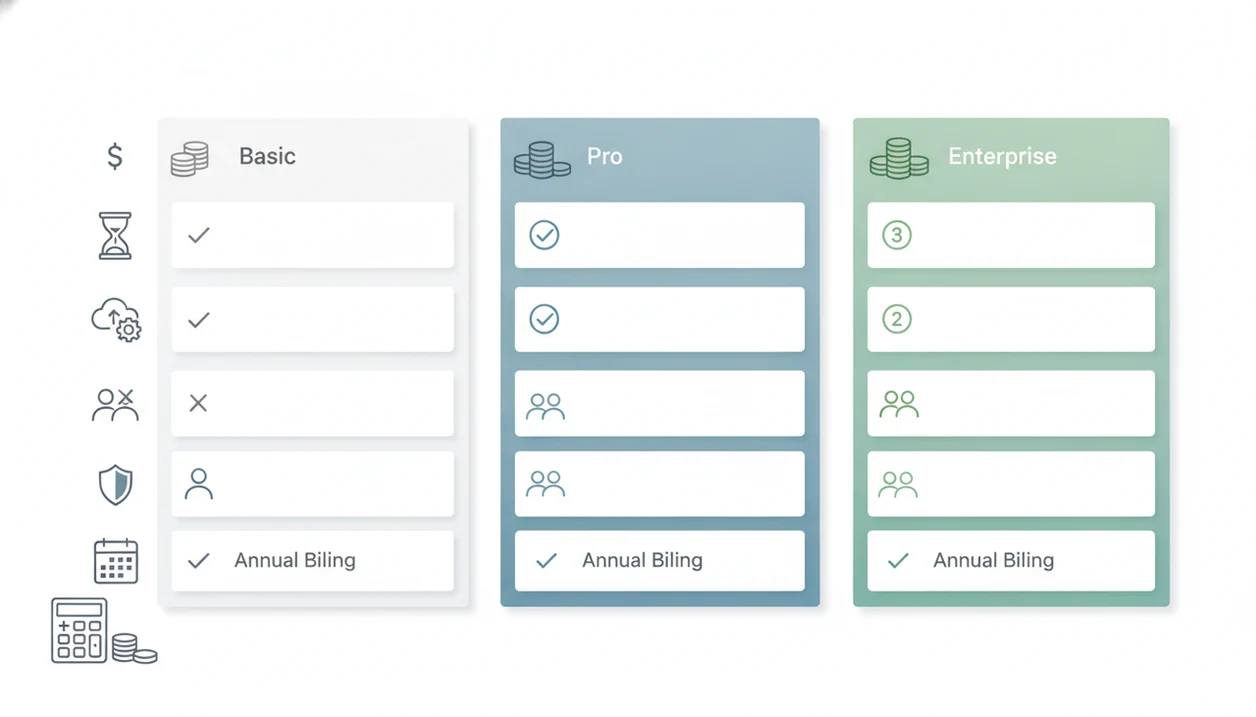
A tool that can compare AI tool pricing should compare the real plan value, not just the advertised monthly fee. The practical approach is to review price, annual discount, usage caps, model access, file and image limits, seats, privacy terms, and your main use case before choosing a subscription.
> Definition: An AI pricing comparison tool is a website, spreadsheet, or app that organizes AI subscriptions side by side by price, limits, features, billing terms, and practical fit.
TL;DR
- Many popular AI subscriptions cluster around $20 per month, so limits often matter more than sticker price.
- Compare AI subscriptions by use case first: writing, research, coding, automation, image generation, or team collaboration.
- Check caps, annual billing, privacy terms, and institutional access before paying for a personal plan.
How tool that can compare ai tool pricing and limits look
Side-by-side captures of the compared products. Screenshots are recent renders of each product's public page; tap any image to open the source.

AI Pricing Comparison Definition for Non-Developers
An AI pricing comparison tool is a website, spreadsheet, or app that organizes AI subscriptions side by side by price, limits, features, billing terms, and practical fit. For non-developers, the point is not to rank every model. The point is to choose the plan that fits the work you actually do.
A useful AI pricing comparison includes paid subscriptions, free tiers, annual billing, usage caps, upload limits, and plan tradeoffs. I’d rather see one honest row for “biology lecture 4.pdf uploads” than ten vague feature badges.
Start with the workflow. If you need research summaries, compare web access and citations. If you need design output, compare image limits. If you need team use, compare seats and admin controls.
Five AI Plan Limits That Change the Real Price
Many major AI subscriptions sit near the same monthly price point, so AI plan limits often decide the real value. ChatGPT Plus was introduced at $20/month in OpenAI's launch note (OpenAI privacy policy); verify current ChatGPT plan pricing at https://openai.com/chatgpt/pricing/. For Claude, Gemini, and Perplexity, check the current provider pages before publishing: https://www.anthropic.com/pricing, https://one.google.com/about/google-ai-plans/, and https://www.perplexity.ai/pro.
- Usage caps: Message caps and rate limits can make two $20 plans feel completely different by Thursday afternoon.
- Free tier restrictions: Free plans may work for casual tasks, but they often limit models, files, speed, or daily usage.
- Annual discounts: Annual billing can reduce the effective monthly price, but it locks you in longer.
- Model access: Some plans reserve stronger models, larger context windows, or faster responses for paid users.
- Use-case fit: A coding assistant, research tool, and image generator should not be judged by price alone.
For a solo user, matching the plan to the task is often better than chasing the cheapest subscription because limits show up during real work.
How AI Pricing Comparison Tools Track Plan Data
AI pricing comparison tools work by turning messy pricing pages into a structured data model. The usual fields are provider, plan, price, billing cycle, usage caps, features, seats, privacy terms, and last verified date.
The technical term is normalization. In plain English, the tool converts monthly and annual billing into comparable numbers, then flags constraints that are easy to miss. A gray pricing toggle that switches from monthly to annual billing can change the whole table.
Good trackers also keep source links and update dates because AI pricing changes often. When I test a comparison sheet, I add a “last checked” column before anything else. Otherwise, a row that looked accurate in March may mislead someone in June.
New AI Blog can sit alongside directories like Futurepedia, Product Hunt, and Toolify for discovery, but its useful role is narrower: plain-English tradeoffs for non-developers comparing AI apps, agents, automation tools, and plan limits.
Before You Start: Gather Your AI Pricing Inputs
Before you compare plans, gather the inputs that make the comparison fair. A clean setup keeps you from chasing a cheap price that does not fit your actual work.
- Write your main workflow first: Name the job you need the tool to do, such as summarizing lecture PDFs, drafting client emails, generating images, coding, research, or team collaboration. This becomes the filter for every plan limit you record.
- Collect live provider URLs: Use the current pricing page, billing page, or help article from each provider. Avoid screenshots, cached snippets, and social posts because AI prices and caps can change without much warning.
- Choose the right plan category: Decide whether you are comparing personal, team, education, or enterprise plans. Mixing these together can make one tool look cheaper or more powerful than it really is.
- Prepare one repeatable test task: Use the same prompt, file, transcript, or image request for every shortlisted tool. That way, the comparison measures real output, not just feature labels.
AI Pricing Comparison Framework Steps for Buyers
Use this AI pricing comparison framework before you compare AI subscriptions. It keeps the decision tied to your work instead of the loudest feature list.
For best results, use only provider pricing pages, billing screens, help docs, and your own test results as inputs. Do not copy prices from screenshots or social posts unless you can verify them on the provider's site.
- Define your use case: Write down whether you need writing, research, coding, automation, image generation, file analysis, or team collaboration.
- Log the advertised prices: Record monthly price, annual effective price, and whether the plan has a free tier.
- Record the limits: Add message caps, file uploads, image credits, model access, context window, web access, and seat rules.
- Calculate your real monthly cost: Include taxes, add-ons, annual lock-in, and any extra seats your team needs.
- Shortlist two or three plans: Test them with one low-stakes task before you connect work files or upload sensitive documents.
A step-by-step test beats a feature checklist when two plans look equal on price. The broader process overlaps with how to evaluate AI tools.
AI Subscription Comparison Table Fields to Track
An AI subscription comparison table makes hidden limits visible. Build the table before you buy, especially if you’re comparing AI plan limits across chatbots, research tools, and image apps.
| Tool | Plan | Monthly price | Annual effective price | Free tier | Usage caps | Model access | File uploads | Image generation | Seats | Privacy | Best use case |
|---|---|---|---|---|---|---|---|---|---|---|---|
| ChatGPT | Plus | $20 | Check current page | Yes | Messages may vary | Paid models | Yes | Yes | 1 | Check settings | General work |
| Claude | Pro | $20 | Often lower annually | Yes | Messages may vary | Paid models | Yes | Limited by plan | 1 | Check settings | Writing, docs |
| Perplexity | Pro | $20 | Check current page | Yes | Search limits vary | Pro search/models | Limited by plan | Limited by plan | 1 | Check settings | Research |
| Your tool | Your plan | Fill in | Fill in | Fill in | Fill in | Fill in | Fill in | Fill in | Fill in | Fill in | Fill in |
I usually add a notes column for “Q3 campaign notes.docx test.” Small detail, but it catches tools that summarize well and then invent action items.
Example note: 'Uploaded a 38-page lecture PDF; tool found the section headings but missed two citation dates.' One concrete test like that is easier to compare than a generic 'good for PDFs' label.
Where to Verify AI Pricing Data
Verify AI pricing data at the provider, not from screenshots, social posts, or old comparison tables. The safest comparison row uses the current pricing page, support documentation, checkout screen, privacy page, and a visible last-verified date.
- Open the official pricing page: Record the monthly price, annual effective price, free tier, and whether the page is showing a personal, team, education, or enterprise plan.
- Check the help center: Look for message caps, throttling, upload size, image credits, context limits, and “fair use” language. These details often explain why two similar prices behave differently in real work.
- Review the checkout screen: Confirm taxes, currency, regional pricing, annual discounts, add-ons, and seat counts before treating the listed price as final.
- Save the privacy-policy URL: Do this before uploading work files, student documents, client notes, or school PDFs. A pricing win is not useful if the data terms do not fit your setting.
- Add a last-verified date: Put the date in every row, even for familiar tools. AI plans change fast enough that an undated row should be treated as a draft, not a recommendation.
AI Pricing Comparison Checks Before You Pay
“Is the paid AI plan actually worth upgrading to?” Compare the free tier against the paid subscription using the same task, not two different tasks. Paste the same short meeting transcript into both and check output quality, missing context, and invented details.
Before paying, check annual billing, taxes, regional pricing, add-ons, cancellation terms, and refund rules. The checkout page is often where the real price appears. The pocket check is real.
Also look for institutional access. Some universities and employers provide no-cost or approved AI tools, so a personal subscription may be unnecessary. If privacy matters, read pricing and privacy pages together before uploading files; the AI app privacy safety guide covers the questions to ask first.
For people comparing personal subscriptions, the AI tool pricing guide is a useful companion to a spreadsheet.
Common AI Plan Limits People Miss
The common AI plan limits people miss are message caps, rate limits, context window, file upload limits, image generation limits, web access, team seats, admin controls, and privacy defaults. These limits rarely fit neatly into the headline price.
Some providers disclose caps clearly. Others use phrases like “limited access,” “fair use,” or “availability may vary.” That makes exact AI pricing comparison harder than comparing normal software subscriptions.
Three browser tabs of AI dashboards can look similar until one stops accepting uploads during a deadline. That’s the awkward part.
Specialized workflows may also need a specialized tool instead of the cheapest chatbot. A marketer testing ad copy variants in neat rows may need export options. A student working with PDF chapters stacked in tabs may care more about citations. For price-only browsing, best AI tools under $20 can help, but use-case fit still comes first.
Understanding Results
AI tools that compare pricing can save time, but they still need verification against the provider’s current pricing page. Treat the comparison as a starting point for evaluation, including plan limits, privacy terms, and realistic usage needs.
This guide works best when
- Comparing AI apps with similar monthly prices
- Checking usage caps, file limits, seats, and model access
- Shortlisting AI tools for writing, research, coding, or automation
- Spotting annual billing discounts and free tier tradeoffs
- Reviewing privacy differences between personal, team, and enterprise plans
This guide may be less accurate when
- Prices that change after the comparison was published
- Taxes, regional pricing, currency conversion, and add-ons
- Vague fair-use limits or unpublished throttling rules
- Affiliate rankings that may favor higher-commission AI tools
- AI agents or team plans that require custom sales quotes
Read more
FAQ
Can AI compare prices?
AI can help organize price data into a table, calculate annual versus monthly costs, and summarize plan differences. You should still verify prices on each provider’s pricing page before paying.
What is AI pricing comparison?
AI pricing comparison is the side-by-side evaluation of AI plans by price, limits, features, billing terms, and practical value. It helps users compare AI subscriptions beyond the monthly fee.
How do I compare AI subscriptions?
Define your main use case, record each plan’s price, list caps and included features, then test the strongest options with the same task. New AI Blog covers this kind of practical comparison for non-developers.
Are free AI tools enough?
Free AI tools can be enough for casual use, quick drafts, and light research. Paid plans become more useful when you need higher caps, better models, file uploads, images, or team features.
Which AI plans cost about $20 per month?
ChatGPT Plus, Claude Pro, Gemini AI Pro, and Perplexity Pro are commonly listed near the $20 monthly price point. Check current provider pages because pricing can change.
Do annual AI plans save money?
Annual AI plans can lower the effective monthly price. They also reduce flexibility because you commit before knowing whether the tool will keep fitting your workflow.
What AI limits matter most?
The most important AI limits are message caps, file uploads, image generation, context window, seats, web access, and model access. Privacy and admin controls also matter for work use.
Should teams compare AI plans differently?
Teams should compare seats, admin controls, privacy terms, collaboration features, and enterprise pricing. New AI Blog generally treats team plans as a separate buying decision from personal subscriptions.