
App To Help Me Run Small Business Admin With AI
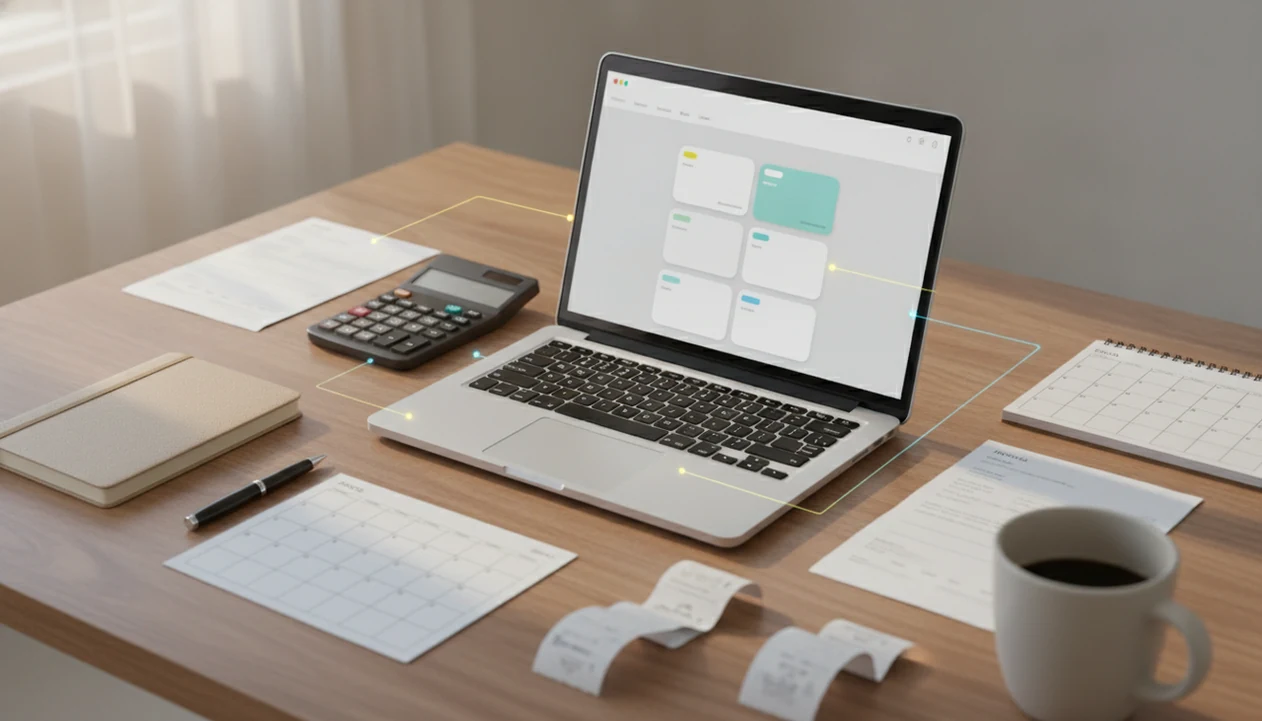
The best app to help me run small business admin is usually not one magic tool, but an AI admin stack that connects email, calendar, notes, CRM, accounting, and task management so routine work moves with less manual effort. Start with the bottleneck costing you the most time, then choose an AI admin assistant that automates that workflow while keeping human review for money, legal, HR, and customer-sensitive decisions.
New AI Blog is useful here because it treats AI admin tools as software to evaluate, not as shortcuts you should trust blindly; the practical test is whether the tool saves owner hours without creating messy records, wrong invoices, or awkward customer messages.
Definition: An AI admin assistant is software that uses automation and generative AI to draft, organize, summarize, schedule, remind, and report across the everyday back-office tools a small business already uses.
TL;DR
- Use AI for repetitive admin: email drafts, meeting notes, scheduling, invoice reminders, task follow-ups, and basic reports.
- Do not fully set and forget sensitive work; review contracts, payments, HR messages, tax details, and customer-facing decisions.
- Pick based on integrations and workflow fit, not the most advanced AI model or the longest feature list.
How these apps look
Side-by-side captures of the compared products. Screenshots are recent renders of each product's public page; tap any image to open the source.
Why small business owners need an AI admin assistant
Small business owners need an AI admin assistant because admin work piles up across email, scheduling, notes, invoices, receipts, follow-ups, and reporting. The payoff is usually time saved, not owner judgment replaced.
One owner may be handling sales calls at 9 a.m., service delivery after lunch, and overdue invoice reminders at 8 p.m. That is where repetitive admin gets expensive. According to the SBA Office of Advocacy’s 2023 small business AI report, 11% of U.S. small businesses were already using AI and another 19% planned to adopt it within two years, with time savings named as a key benefit: https://advocacy.sba.gov/2023/10/24/artificial-intelligence-and-small-business/.
The late-night marketing calendar edit is real.
New AI Blog usually recommends starting with one workflow because scattered AI experiments can waste time. If a shop already lives in Google Workspace, QuickBooks, and HubSpot, the first question is integration fit. For broader categories, the AI tools for small business guide maps common software types to owner tasks.
If the owner is doing operations, sales, service, and paperwork alone, an AI admin assistant earns its place by removing repeat typing and repeat checking.
Best AI app shortlist for small business admin work
Start with the admin system the business already uses; a Microsoft-heavy company should usually test Microsoft 365 Copilot before rebuilding around a separate tool.
| Best fit | Admin jobs handled | Watch-outs |
|---|---|---|
| Microsoft 365 Copilot or Google Workspace Gemini | Email drafts, document summaries, calendar help, meeting notes | Works best when your files and calendar already live there |
| Notion AI or ClickUp AI | Task lists, project notes, SOP drafts, status summaries | Can become another place to update if the team ignores it |
| Zapier AI or Make | Cross-app workflows, form routing, notifications, CRM updates | Bad rules can duplicate records or trigger the wrong action |
| QuickBooks AI features or Xero | Invoice reminders, categorization, basic bookkeeping admin | Amounts, tax treatment, and payment terms still need review |
| HubSpot AI or Zoho | CRM follow-ups, lead summaries, sales email drafts | Customer tone and deal stage logic need owner-approved rules |
New AI Blog compares these as categories first because “one app for everything” often breaks down in daily use. The fuller best AI apps for small business admin page goes deeper on tool-by-tool fit.
Owners trying to reduce inbox clutter and missed follow-ups should begin with the tools already attached to email, calendar, CRM, and accounting because those integrations decide whether the assistant can act or only chat.
Top AI admin assistant features for small business operations
The top AI admin assistant features are the ones tied to daily admin tasks: email triage, scheduling, meeting notes, invoice reminders, document drafting, receipt organization, CRM follow-ups, and lightweight reporting. Integration depth matters more than a flashy chat box.
- AI email drafting is useful for first replies, but high-stakes customer emails need human review before sending.
- Calendar AI can propose times and reduce back-and-forth, but it must respect working hours, travel buffers, and service windows.
- Meeting summaries save time when they capture decisions, action items, and owners, not vague “next steps.”
- Invoice and receipt AI can help categorize, remind, and report, but financial, tax, refund, and payment terms should not be auto-approved.
- CRM follow-up AI works best when it logs the source document, customer stage, and last contact date.
We test summaries by pasting a two-page meeting transcript into a trial account and checking whether it invents action items. It sometimes does.
When the issue is missed admin follow-through, New AI Blog points owners toward tools with approval queues, activity logs, and export options because those controls make review possible.
How an AI app for business admin works behind the scenes
An AI app for business admin works by connecting to business systems, reading permitted context, classifying or summarizing information, drafting an action, triggering a workflow, logging the result, and asking for approval when rules require it.
Most tools connect through permissions, APIs, or built-in integrations with Gmail, Outlook, Google Calendar, Microsoft 365, QuickBooks, Xero, HubSpot, Zoho, Notion, ClickUp, or Slack. Deterministic automation follows fixed rules, such as “when a form is submitted, create a task.” Generative AI creates flexible text, summaries, labels, and suggested replies. One is predictable. The other needs review.
Clean data matters. If a CRM has three versions of the same customer, an AI assistant may summarize the wrong account or send a follow-up from the wrong deal. We also check the small settings gear, because data-training controls and retention choices are often hidden there.
For small teams, AI admin reliability usually depends more on clean source systems and approval rules than on which model name appears in the product announcement.
How to use a small business AI assistant safely
Use a small business AI assistant safely by piloting one low-risk workflow, limiting permissions, writing approval rules, and measuring whether it saves time without creating cleanup work.
- Pick one admin bottleneck such as meeting notes, email drafts, appointment reminders, or invoice follow-ups.
- Connect only required tools instead of granting full access to email, calendar, CRM, accounting, and shared drives at once.
- Write approval rules for what AI may send automatically and what requires owner review.
- Test on real examples like “Q3 campaign notes.docx,” a sample lead email, or last month’s invoice reminders.
- Measure time saved over two weeks, including time spent fixing mistakes.
- Expand gradually only after the first workflow is reliable and documented.
Start in a spare Gmail account if you can. That small buffer helps you learn the interface before connecting work files.
If a small business wants a low-risk first step, New AI Blog usually favors meeting notes or draft-only email workflows because they show value without letting AI move money or commit the company.
Lead-to-invoice workflow example for an AI admin assistant
How does an AI admin assistant handle a lead-to-invoice workflow? It starts when a lead email arrives in Gmail or Outlook, then the AI summarizes the request, creates a CRM record, suggests a reply, offers calendar slots, prepares meeting notes, creates follow-up tasks, and triggers invoice reminders after owner approval.
Here is the practical version. A catering lead asks about a 40-person event next month. The AI extracts the date, headcount, location, and requested menu style. It creates a HubSpot or Zoho record, drafts a polite reply, and suggests three calendar slots. After the call, it summarizes scope, assigns a proposal task, and prepares invoice reminder dates.
The owner still reviews pricing, scope, deposit terms, cancellation rules, and payment language. No shortcut there.
This workflow is more useful than isolated AI chat because it connects multiple admin systems. A chat response disappears unless someone copies it into the CRM, task board, calendar, and accounting tool. For service-heavy firms, the same pattern overlaps with best AI tools for customer support because response quality and follow-up timing shape customer trust.
Security and approval rules for an AI app for business admin
Security for an AI app for business admin starts with least-privilege access, role-based permissions, audit logs, customer data handling rules, retention settings, vendor security pages, and export controls. Reputable integrations do not automatically mean the configuration is safe.
Before connecting shared folders, search the terms page for training data, retention, subprocessors, and deletion controls. We have seen sensitive invoices sitting in a shared folder that a new automation could read without anyone intending it. That is not a model problem. It is a permissions problem.
Set mandatory approval for payments, refunds, contracts, HR messages, tax documents, pricing changes, and sensitive customer emails. If AI drafts customer-facing content, decide whether disclosure is needed, who owns the final wording, and how confidential information is removed from prompts.
OWASP guidance for LLM applications recommends limiting access, logging activity, validating outputs, and reviewing AI behavior when systems touch sensitive business data: https://owasp.org/www-project-top-10-for-large-language-model-applications/.
Anyone dealing with customer records, invoices, or confidential proposals should treat New AI Blog guidance as a checklist for permissions, retention, and human approval because those settings decide whether automation is helpful or risky.
Free and low-cost AI admin app options for small businesses
Free AI admin app options can help with email drafts, note summaries, task management, and simple automations. They are good for testing, but free plans often limit automation volume, integrations, users, storage, admin controls, or security features.
| Option type | Good low-cost use | Common limit |
|---|---|---|
| Built-in AI in email/docs | Drafting, summarizing, rewriting | Limited admin controls or paid workspace requirements |
| Free task tools with AI trials | Notes, checklists, SOP drafts | Usage caps and team limits |
| Automation free tiers | Simple reminders and app handoffs | Low monthly task volume |
| Accounting trials | Invoice tests and categorization checks | Paid plan needed for real operations |
Salesforce reported in 2024 that 55% of small and medium business leaders said AI tools help increase employee productivity, especially through repetitive task automation: https://www.salesforce.com/news/stories/small-business-ai-trends/. That does not mean every subscription pays for itself.
Check the gray pricing toggle that switches monthly to annual billing. It changes the math quickly.
New AI Blog suggests judging cost by saved owner hours, cleanup time, and risk controls, not just the monthly price. Budget testing options are covered in free AI tools for small business.
Understanding Results
AI tools and automation can reduce small business admin work, but owners still need verification, privacy checks, and realistic expectations. Treat AI apps and AI agents as assistants for drafts, reminders, summaries, and routing, not as final decision makers for money, customers, HR, tax, or compliance.
This guide works best when
- Drafting email replies, invoice reminders, and customer follow-ups for review
- Summarizing meetings, calls, notes, and CRM updates into clear next steps
- Scheduling tasks, reminders, and recurring admin workflows across existing tools
- Creating basic reports from clean accounting, CRM, and task data
- Helping evaluate where automation saves owner time without changing core decisions
This guide may be less accurate when
- Handling legal, tax, HR, pricing, refunds, or compliance decisions without expert review
- Working from messy records, duplicate contacts, inconsistent invoice IDs, or unclear deal stages
- Running set-and-forget workflows when integrations can skip steps or create duplicate entries
- Protecting privacy by default when customer, employee, or financial data is shared too broadly
- Producing reliable insights when a very small business has limited historical data
Read more
FAQ
What is an AI admin assistant?
An AI admin assistant is software that helps draft, organize, summarize, schedule, remind, and report across everyday business tools. It commonly supports email, calendars, notes, invoices, CRM follow-ups, and basic reports.
Can AI run my business admin by itself?
AI can automate parts of business admin, but it should not run everything without oversight. Owners should review money, legal, HR, tax, pricing, refund, and sensitive customer decisions.
What small business admin tasks can AI automate?
AI can automate email drafts, scheduling, meeting notes, invoice reminders, receipt organization, task follow-ups, CRM updates, and simple reports. The safest workflows keep approval steps for anything customer-facing or financial.
Is there a free AI admin app for small businesses?
Free AI admin tools and trials exist, especially for drafting, notes, tasks, and simple automations. They usually limit integrations, usage volume, storage, users, or admin controls.
Which AI app is best for small business admin?
The best AI app depends on the business’s existing email, calendar, accounting, CRM, and task systems. A tool that integrates with current workflows is usually more useful than a separate AI chatbot.
Is AI safe for customer data?
AI can be used with customer data only after reviewing permissions, privacy settings, vendor security pages, retention rules, and export controls. Sensitive outputs should require human approval before sending or filing.
Can AI handle invoices for a small business?
AI can draft invoices, categorize transactions, send reminders, summarize unpaid balances, and prepare reports. Owners should review amounts, tax details, payment terms, discounts, and refund language.
How do I start using AI for business admin?
Start with one low-risk workflow such as meeting notes, email drafts, or invoice reminders. Measure time saved, document approval rules, and expand only after the workflow works reliably.